Abstract
This research paper proposes a well detailed and logical framework for understanding the basic concepts of the Intellectual Property Rights and the paradigm shift that is coming in the traditional Indian trademark law from conventional visual identifiers to non-conventional sensory marks. The research will first delve into the broader aspect of IPR by defining its fundamental tenets and then will proceed towards the concept of trademark, particularly towards the traditional categorization of trademarks into word marks and device marks to highlight the traditional reliance on visual branding. It then delves into the ravelled legal and scientific framework surrounding olfactory (smell) marks. Prompted by the recent landmark acceptance of India’s first olfactory trademark, this paper critically examines how the strict legal barrier of ‘graphical representation’ was finally overcome. Ultimately, this research aims to analyze the practical and legal challenges that this new acceptance now poses for corporations, particularly regarding the functionality doctrine, registration costs, and the evidentiary burdens of proving brand distinctiveness.
Chapter 1: Introduction
1.1 Concept of Brand Identity
In the modern day hyper-competitive market, corporations or companies are continuously looking for creative ways or strategies to differentiate their products and capture consumer loyalty. Historically the concept of brand marketing has predominantly focused on visual stimuli, i.e., logos, brand name and distinct colour scheme, thus shaping the way brands establish identity and recognition. But in a fast paced market, these traditional visual identifiers are failing marginally to cut through market noise and forge lasting consumer loyalty. Thus the modern corporate is shifting towards sensory branding as it is rooted in neuroscience and what it does is it creates a deep, psychological connection with consumer. In the realm of sensory branding, olfactory sense (smell) is the strongest as it is uniquely wired to the brain’s limbic system thus allowing brands to trigger subconscious recognition and thus farming loyalty.
1.2 Introduction to Trademarks
To commercialize and protect these brand identities in India, corporations rely on the baseline of Intellectual Property Rights (IPR). Under the Trademarks Act, 1999, the trademark fundamentally serves to identify the source and its primary use is to differentiate the goods or services of one company from other, thus protecting the brand’s goodwill and also preventing the confusion among consumers. But at the same time if we look down, historically these statutory frameworks were built thinking only about the visual marks thus protecting the traditional marks (word mark and device mark) as they were operating under the assumption that a trademark can only be seen.
1.3 The Core Problem: Non-Conventional Marks and the Legal Bottleneck
The move from traditional trademarks to sensory marks has forced the trademarks registry to work in touch with non-conventional marks, i.e., sounds, shapes and colors but universally the olfactory marks have faced constant rejection because of a statutory bottleneck which is “graphical representation” as under “Section 2(1)(zb) of Trademarks Act, 1999, trademark means a mark which is capable of being represented graphically.”[1]This is done deliberately just so to ensure that the consumers as well as the competing business can have an idea of what the product is. Globally, this standard was set through the landmark Sieckmann Case, where;
“The case involved a “methyl cinnamate” scent, which the applicant had described “as balsamically fruity with a slight hint of cinnamon”. The ECJ ruled that (a) a chemical formula depicting this scent did not represent the odour of a substance, was not sufficiently intelligible, nor sufficiently clear and precise; (b) a written description was not sufficiently clear, precise and objective; and (c) a physical deposit of a sample of the scent did not constitute a graphic representation, and was not sufficiently stable or durable.”[2]
Smell Marks failed this test for decades causing small written descriptions (floral air freshner) to be considered too subjective and written chemical formulas only represented the chemicals.
1.4 The Catalyst: The Indian Breakthrough (November 2025)
For decades this skepticism was followed by the Indian Trademark regime. However the turning point occurred on November 21, 2025 when for the first time India’s first-ever olfactory trademark application was accepted by the Controller General of Patents, Designs and Trademarks (CGPDTM). To ensure they meet the formal standards for trademark eligibility in India, the Registry moved beyond subjective perception by requiring smells to be translated into reproducible, technical data, thereby confirming that fragrance marks can satisfy the graphical representation criteria of “Section 2(1)(zb).”[3]
1.5 Thesis Statement and Research Roadmap
Although the precedent set by this landmark case demonstrates that India now permits the registration of scent-based trademarks, this milestone simultaneously triggers a multitude of complex administrative and commercial dilemmas. The central argument of this dissertation is that this novel legal recognition imposes rigorous obstacles on businesses. Specifically, corporations will struggle with navigating the functionality doctrine, managing the inherent subjectivity involved in proving sensory infringement, and meeting the heavy evidentiary standards required to establish acquired distinctiveness. To thoroughly examine these issues, the subsequent chapters systematically break down the relevant legal structures. Building upon this introductory chapter, the study investigates the general rise of unconventional trademarks before undertaking a deep dive into the international legal history of olfactory marks. It then unpacks the procedural mechanisms behind India’s recent policy shift and concludes by assessing the concrete operational and strategic difficulties that enterprises must tackle within this evolving domain of intellectual property law.
Chapter 2: The Emergence of Non-Traditional Marks
2.1 The Commercial Shift: Need for Sensory Branding
The conventional paradigm of brand protection was constructed during an era where commerce was largely cramped to print media and store fronts but as the market advanced hyper-saturation within the contemporary commercial environment has subjected the public to a continuous influx of promotional stimuli. Consequently, this sensory overload has manifested as visual fatigue, diminishing the impact of brand messaging. To evade this, the corporate marketing teams have found a way in which by integrating the principles of neuromarketing and cognitive psychology, brands have endeavored to cultivate “sensory branding”, i.e., a multidimensional approach used to simulate the mind of the consumer to leave a profound, immediate and long-lasting emotional connection using hearing, touch and smell. As more business started using these sensory identifiers by investing huge sum of money, a substantial gap started developing between the traditional, visually oriented statutory frameworks and the commercial reality of modern branding.
2.2 Non-Traditional Trademarks
The jurisprudence of trademark had to evolve to bridge this gap, thus facilitating the conceptualization of Non-Traditional Marks (NTMs). The definition of Non-Traditional Marks is:
“A non-conventional trademark, also known as a nontraditional trademark, is any new type of trademark which does not belong to a pre-existing, conventional category of trade mark, and which is often difficult to register, but which may nevertheless fulfill the essential trademark function of uniquely identifying the commercial origin of products or services.
The term is broadly inclusive as it encompasses marks which do not fall into the conventional set of marks (e.g. those consisting of letters, numerals, words, logos, pictures, symbols, or combinations of one or more of these elements), and therefore includes marks based on appearance, shape, sound, smell, taste and texture.
Non-conventional trademarks may therefore be visible signs (e.g. colors, shapes, moving images, holograms, positions), or non-visible signs (e.g. sounds, scents, tastes, textures).”[4]
World Intellectual Property Organization (WIPO) provides a more direct, layman definition of NTM’s in their official publication as:
“So-called ‘non-traditional’ marks can consist of color alone, three-dimensional signs, sounds, or anything else that functions as a mark and otherwise meets the requirements of the jurisdiction in which registration is sought.”[5]
The Indian legislative framework also recognized this immediate and necessary evolution with the enactment of the “Trade Marks Act, 1999 and under Section 2(1)(zb),”[6]the statutory definition of a trademark was deliberately broadened to encompass the “shape of goods, their packaging and combination of colours.”
2.3 Navigating the Graphical Barrier: Legal Adaptations for Early NTM’s
The legal system had to test the waters with the other forms of NTM’s even before they could consider the complexities of olfactory marks. The pavement of the way for the broader sensory protection went through the successful registration of these intermediate marks:
l Sound Marks: As their name suggests, sound marks are the marks that have a specific sound or melody, which helps by distinguishing goods from competitors. These auditory identifiers were among the first NTM’s to be recognized or gain legal recognition. Examples of sound marks are ICICI Bank’s jingle sound and Netflix “Tudum”.
l Colour Marks: A mark that is exclusively of a single colour or combinations of colours and it has to be non conventional and non-verbal and primarily it is used to identify the commercial origin of products is called a colour mark. The protection of a single color or a specific combination of colors presented another challenge. Registries eventually permitted color marks by allowing applicants to utilize internationally standardized color identification systems, such as the Pantone Matching System, to accurately represent the mark on paper. Notable global examples include the distinct red soles of Christian Louboutin footwear and the bright pink colour used by Mattel for Barbie dolls. However, courts maintain an exceptionally high evidentiary burden for color marks, requiring extensive proof of “acquired distinctiveness” through prolonged commercial use.
l Shape Marks (3D Marks): As the name suggests, it is the kind of mark that uses a three-dimensional projection to protect the three-dimensional shape of a product. The physical, three-dimensional contour of a product or its packaging can also be trademarked, provided the shape is entirely arbitrary and not dictated by the product’s function. This graphical requirement was satisfied through the submission of precise technical drawings, blueprints, or CAD (Computer-Aided Design) models. The classic contoured Coca-Cola bottle and the triangular prism packaging of Toblerone chocolate stand as quintessential examples of successful shape marks.
2.4 Universal Problem of Graphical Representation and Transition to the Uncharted Territory
Graphical Representation had faced an issue for a longer period of time that the previously mentioned NTM’s surpassed, i.e., their ability to be translated into visual format. Sounds were translated into sheet music, colors were translated into alphanumeric Pantone codes, and shapes were translated into two-dimensional technical sketches.This reinforces the historical reality that trademark registries, including India’s, operated under a strict visual bias and the golden rule remained inflexible, if a mark could not be objectively and visually recorded in the trademark journal for the public and competitors to scrutinize, it could not be granted statutory protection. Because an odor could not be sketched, coded, or written in a manner that was simultaneously objective, precise, and durable, olfactory marks became the ultimate stress test for the flexibility of intellectual property law. This inherent subjectivity and the lack of a visual workaround set the stage for decades of universal rejection, establishing the complex legal friction that olfactory marks would eventually have to overcome.
Chapter 3: Olfactory Marks
3.1 The Conceptual Framework: What Constitutes an Olfactory Mark?
It is crucial to establish what a smell mark is before navigating through the hurdles of the jurisprudence of Olfactory Marks. An Olfactory Trademark is non conventional mark wherein a specific scent serves as the primary commercial source identifier, enabling a consumer to recognize a brand entirely through the sense of smell. However, the legal recognition of a smell mark is strictly governed by the “functionality doctrine.” Under trademark law, a scent cannot be registered if it is a natural byproduct of the manufacturing process or if it serves a functional, utilitarian purpose for the product itself. For example, a manufacturer cannot claim trademark protection for the scent of lemon in a lemon-scented dishwashing liquid, as the fragrance is a primary functional feature of the goods.
The global standard for an acceptable, non-functional scent mark was established in the landmark United States case of ‘In Re Clarke”[7] where the Trademark Trial and Appeal Board (TTAB) granted protection to a “high impact, fresh, floral fragrance reminiscent of Plumeria blossoms” specifically applied to sewing thread and embroidery yarn. The TTAB allowed the registration because the scent was entirely arbitrary and fanciful; sewing thread does not naturally possess a floral odor, nor does the scent improve the physical function of the thread, thereby serving purely as a unique identifier of commercial origin.[8]
3.2 The Inherent Subjectivity of Scent and Historical Rejection
Olfactory marks have faced universal rejection from trademark registries across the world despite the commercial viability shown by cases like In Re Clarke. This historical reluctance’s core lies in the inherent biological and chemical subjectivity of human olfaction. “The World Intellectual Property Organization (WIPO), in its assessment of new types of marks, has explicitly noted the complexities associated with non-visible signs, particularly concerning the statutory requirement that a mark must be capable of graphical representation.”[9]
The case of olfactory senses are highly subjective as the sense of smell is profoundly influenced by external factors which are environmental (such as temperature and humidity) and the subjective neurological receptors of the individual consumer. Now the issue is that the trademark registries function on a strict public notice system, i.e., competitors must be able to consult a trademark journal to understand precisely what intellectual property is protected. Now earlier the catch was that a scent could not be sketched or photographed, applicants fundamentally struggled to provide a representation that the law deemed sufficiently objective.
3.3 The Global Jurisprudence: The Sieckmann Threshold
As mentioned earlier that in the case of “Ralf Sieckmann v. Deutsches Patent und Markenamt, the ECJ rejected the application, ruling that none of these methods successfully represented the mark. In delivering this judgment, the Court established the famous “Sieckmann Criteria,” mandating that any graphical representation of a non-conventional mark must be strictly clear, precise, self-contained, easily accessible, intelligible, durable, and objective.”[10]
3.4 The Consequent Legal Deadlock
The registration of olfactory marks was effectively paralyzed by the judgement in the Sieckmann case and through this ruling the ECJ created a jurisprudential paradox, i.e., the law acknowledged that a smell conceptually possessed the capacity to act as a trademark, but simultaneously dictated that existing human language and chemical notation were legally insufficient to record it. This deadlock, where the commercial reality of sensory branding was stifled by the strict boundaries of objective legal representation persisted for decades, creating the exact legal friction that the Indian registry would ultimately have to resolve.
Chapter 4: The Changing Landscape in India
4.1 The Historical Barrier: Section 2(1)(zb) and the Visual Paradigm
The scope of Non-conventional marks in India was historically constrained by a rigid statutory bottleneck, i.e., “section 2(1)(zb) of the Trademarks Act, 1999”[11]as it strictly mandates that a trademark must be capable of “being represented graphically” and for decades, the Indian Trade Marks Registry operated under this strict visual paradigm, interpreting this clause to mean that if a mark could not be drawn, printed, or visually rendered on paper, it could not be placed on the register. As established in the earlier chapter, the European Sieckmann jurisprudence cast a long shadow over Indian administrative practices, along with that written descriptions of smell were considered too subjective, physical samples of smell were impermanent and chemical formulas failed to communicate the actual sensory experience to the consumers thus making the Indian trademark regime to remain structurally hostile towards olfactory marks.
4.2 The Watershed Moment: The Sumitomo Application
“On November 21, 2025, this decades long legal deadlock was decisively broken thus marking a watershed moment in the Indian intellectual property jurisprudence. The Controller General of Patents, Designs and Trade Marks (CGPDTM) accepted India’s first-ever olfactory trademark for advertisement in the Trade Marks Journal.”[12] The applicant, the Japanese multinational corporation Sumitomo Rubber Industries Ltd., sought protection under Class 12 (tyres for vehicles) for a scent formally described as a “floral fragrance / smell reminiscent of roses as applied to tyres” (Application No. 5860303).[13]
Predictable resistance was faces by the application in the initial days as the registry raised standard objections under “Section 9(1)(a) for an alleged lack of distinctiveness and Section 2(1)(zb) for the absence of a valid graphical representation.”[14] To overcome the distinctiveness hurdle, Sumitomo presented a compelling argument based on the “functionality doctrine’ as tyres inherently emit a strong, unpleasant rubber odor thus infusing them with the scent of roses is counter-intuitive and serves absolutely no mechanical or utilitarian function. Therefore, the scent acts purely as an arbitrary and fanciful identifier of commercial origin. However, proving distinctiveness was only half the battle because the insurmountable challenge was the graphical representation of the rose scent.
4.3 The Scientific Solution: The Seven-Dimensional (7D) Olfactory Vector
“Recognizing that traditional legal arguments and verbal descriptions would not satisfy the Registry, the breakthrough in the Sumitomo case was achieved not merely through legal advocacy, but through a pioneering scientific intervention.”[15]Sumitomo’s legal counsel collaborated with researchers and professors from Indian Institute of Information Technology (IIIT), Allahabad, to bridge the gap between the subjective perception and objective legal requirements.
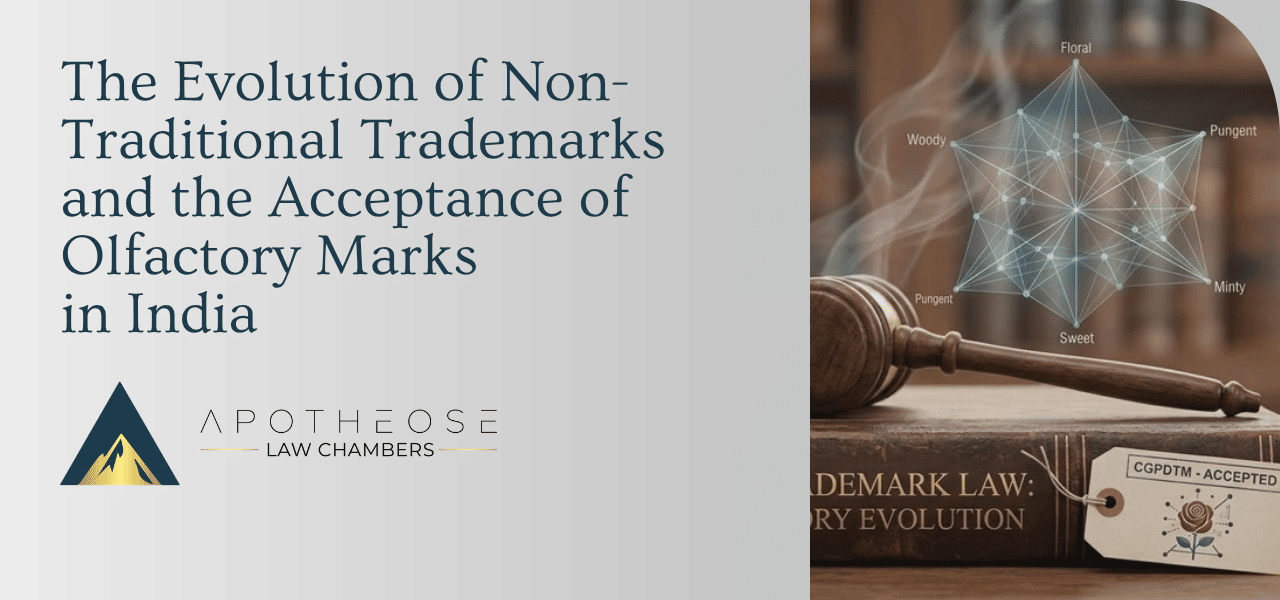
The scientists abandoned the historically flawed approach of submitting chemical equations. Instead, they analyzed the volatile organic compounds that constitute the rose scent and mapped the fragrance across a complex, mathematically derived seven-dimensional (7D) olfactory space. This visual vector quantified the scent based on seven fundamental sensory coordinates, i.e., floral, fruity, woody, nutty, pungent, sweet, and minty. By plotting the precise intensity and interaction of these specific notes, the researchers successfully generated a highly objective, scientifically reproducible scent fingerprint.
4.4 Satisfying the Graphical Representation Criteria
The registry’s approach to the sensory marks was fundamentally altered by the submission of this 7D olfactory vectograph. A highly subjective sensory experience was successfully transformed into an objective, measurable piece of data by the mathematical graph and the vector was deemed clear and precise because it mapped exact intensities across established axes, effectively removing human interpretation from the equation. Unlike a physical perfume sample, the plotted graph was permanent and durable, thus becoming intelligible to competitors who could theoratically recreate the analysis. By officially accepting this innovative methodology, the Indian Trade Marks Registry did not rewrite the existing statute, rather, it acknowledged that modern scientific visualization had finally caught up with the law, fulfilling the strict requirements of the Act and inaugurating a new era of sensory branding.
Chapter 5: Pandora’s Box – The Trials Within
5.1 The Evidentiary Burden of Acquired Distinctiveness
While the procedural hurdle of graphical representation was resolved with the deployment of 7D olfactory vector, it does not act as an automatic guarantee for statutory provision. “A fundamental tenet of trademark law dictates that to warrant a legal monopoly, a mark must posses a distinctive character as enshrined under Section 9(1) of Trademarks Act, 1999.”[16]Now scents are rarely inherently distinctive so consumers are biologically conditioned to perceive odors as environmental background features or mere aesthetic additives rather than as commercial source identifiers thus the applicants bear an astronomical evidentiary burden to prove “acquired distinctiveness.” An exhaustive empirical evidence that the relevant purchasing public exclusively associates that specific scent with their brand has to be shown by a corporation to successfully register an olfactory mark thus necessitating massive, longitudinal consumer surveys, substantial marketing expenditure data, and proof of continuous, exclusive commercial use over an extended timeline.
5.2 The Subjectivity of Sensory Infringement
With the acceptance of the olfactory marks the most complex juristic challenge lies in the realm of enforcement and infringement. The traditional test for trademark infringement hinges on the “likelihood of confusion” and the “imperfect recollection” of the average consumer, a standard famously solidified in Indian jurisprudence by the Supreme Court in “Cadila Health Care Ltd. v. Cadila Pharmaceuticals Ltd.”[17] However it is pertinent to know that, this legal standard was designed only for the visual and phonetic comparisons.
Several logistical challenges can come up for the judiciary while transposing this visual test into the olfactory realm. . If a competing manufacturer produces a tyre with a generic lavender or jasmine scent, how does a presiding judge objectively determine if it is deceptively similar to Sumitomo’s rose scent? Human olfactory memory is not always perfect, and courtroom adjudications would be plagued by “olfactory fatigue”, a biological phenomenon where the human nose rapidly loses its ability to differentiate between concurrent smells. Thus, judges will likely be forced to rely entirely on expensive, competing expert testimonies and complex gas chromatography reports, transforming standard trademark infringement hearings into highly technical, protracted scientific trials.
5.3 The Functionality Doctrine Product Life Cycles
Based on the functionality doctrine, olfactory marks remain uniquely vulnerable to cancellation actions even post registration and trademark law also doesn’t allow perpetual monopoly creation over a useful product feature, which is the proper domain of patent law. Even if the scent is deemed arbitrary at the starting, it’s classification can shift over the product’s life-cycle particularly when the competitors can demonstrate that a specific scent has become necessary to mask the unpleasant odor of a base material thus resulting in the reclassification of the previously registered scent as it is functionally essential to the manufacturing process. This constant threat of functionality based cancellation forces the brand owners to continuously monitor the industry standards to ensure their registered scent remains a purely fanciful identifier rather than an evolving utilitarian necessity.
5.4 The Monopolization of Sensory IP
Even beyond the courtroom, the acceptance of complex scientific methodologies like the 7D vector introduces new implications in the market, particularly for micro, small and medium enterprises (MSMEs) as these enterprises doesn’t have the adequate financial capital and technological advancements when compared with the big multinational conglomerates, thus threatening with the complete monopolization of the competitive market.
Conclusion
With the evolution of modern commerce and corporate, brands have shifted towards sensory branding thus forcing the Indian intellectual property laws to change themselves to confront its inherent visual bias. For decades, the trademarks act, 1999, kept the strict requirement of graphical representation which acted as an insuperable barrier for olfactory marks, thus rendering them as unregistrable abstract concepts. However, the historic acceptance of Sumitomo’s rose-scented tyre application in November 2025 decisively shattered this deadlock by utilizing a mathematical 7D olfactory vectograph and thus the Indian Trade Marks Registry acknowledged that scientific innovation could finally bridge the gap between subjective human perception and objective statutory requirements, effectively solving the graphical representation hurdle.
Yet, as this research paper has demonstrated, this scientific breakthrough is just a procedural triumph which is opening a Pandora’s Box of substantive, regulatory and commercial challenges. In this highly perilous journey, the first step was to satisfy the registry but now applicants face an enormous evidentiary burden of proving an acquired distinctiveness because human olfaction is inherently subjective. Along with that the constant danger coming from the functionality test ensures that an olfactory mark in never entirely secure.
Even keeping the registration aside, the enforcement of these marks threatens to severely strain the judiciary because transposing traditional visual infringement tests onto invisible, fleeting scents is practically unworkable, inevitably forcing courts to rely on expensive, hyper-technical expert testimonies and chemical data. Concurrently, the immense financial capital required to map and litigate these sensory marks establishes a prohibitive barrier to entry. This dynamic risks allowing highly capitalized multinational conglomerates to monopolize sensory branding, effectively sidelining smaller enterprises and distorting market competition.
At last, it is a commendable step toward modernizing intellectual property law in India by accepting the first smell mark, using a statutory framework originally designed for two-dimensional logos to govern multidimensional sensory marks in inherently flawed. The legislature and judiciary has to proactively develop specialized, standardized examination guidelines and distinct infringement tests tailored specifically for sensory marks, if India wants to successfully navigate this new era of non-conventional branding. Until such a comprehensive framework is established, the pursuit of an olfactory trademark will remain not just a monumental legal achievement, but a formidable commercial gamble.
—
[1] The Trademarks Act, 1999 (Act No. 47 of 1999)
[2] “Ralf Sieckmann v Deutsches Patent und Markenamt,” Wikipedia, available at:https://en.wikipedia.org/wiki/Ralf_Sieckmann_v_Deutsches_Patent_und_Markenamt (last visited on 13 April 2026).
[3] The Trademarks Act, 1999 (Act No. 47 of 1999)
[4] “Non-conventional trademark”, Wikipedia, available at: https://en.wikipedia.org/wiki/Non-conventional_trademark(Last visited on April 16, 2026).
[5] World Intellectual Property Organization, “Protecting Your Marks Abroad” 4 (2006), available at: https://www.wipo.int/edocs/pubdocs/en/marks/1039/wipo_pub_1039.pdf(Last visited on April 16, 2026).
[6] The Trademarks Act, 1999 (Act No. 47 of 1999)
[7] In re Clarke, 17 U.S.P.Q.2d 1238 (TTAB 1990)
[8] Ibid
[9] World Intellectual Property Organization, “New Types of Marks” 2 (Sept. 1, 2006), available at: https://www.wipo.int/edocs/mdocs/sct/en/sct_16/sct_16_2.pdf(Last visited on April 21, 2026).
[10] Ralf Sieckmann v. Deutsches Patent- und Markenamt, Case C-273/00, [2002] ECR I-11737
[11] The Trademarks Act, 1999 (Act No. 47 of 1999)
[12] Order of the Trade Marks Registry, Application No. 5860303 (Nov. 21, 2025) (India)
[13] World Intellectual Property Organization, “India’s first smell mark: Sumitomo rose-scented tires”, WIPO Magazine (April 19, 2026), available at: https://www.wipo.int/en/web/wipo-magazine/articles/indias-first-smell-mark-sumitomo-rose-scented-tires-89623 (Last visited on April 21, 2026).
[14] The Trademarks Act, 1999 (Act No. 47 of 1999)
[15] “Decoding India’s first accepted Smell Trademark: ‘Rose-Fragranced Tyres'”, The Leaflet (Nov. 27, 2025), available at: https://theleaflet.in/digital-rights/law-and-technology/decoding-indias-first-accepted-smell-trademark-rose-fragranced-tyres(Last visited on April 21, 2026).
[16] The Trademarks Act, 1999 (Act No. 47 of 1999)
[17] (2001) 5 SCC 73