“We, the People of India, having solemnly resolved to constitute India into a Sovereign Socialist Secular Democratic Republic and to secure to all its citizens Justice, Liberty, Equality, and Fraternity…” — so opens the Preamble to the Constitution of India.
Seventy-six years later, that promise is being tested. Freedom House has downgraded India from “Free” to “Partly Free,” placing the world’s largest democracy in the same bracket as nations that have never claimed the title seriously.[1] A single recent moment that crystallised the crisis was in December 2023, when over 140 MPs were suspended from the Winter Session in a single sweep, the largest mass suspension in independent India’s history.[2]
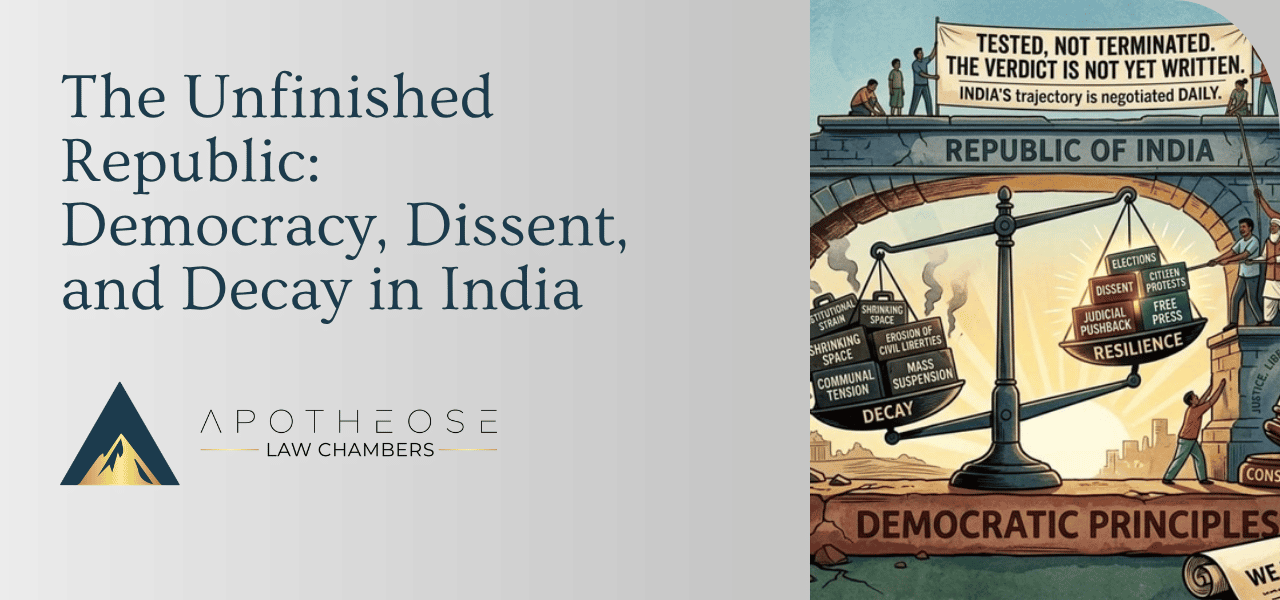
India today exhibits clear signs of democratic backsliding such as institutional strain, shrinking deliberative space, and eroding civil liberties. Still, it does not amount to collapse. Elections still produce results the ruling party does not want; the judiciary still pushes back; citizens still protest. India’s democracy is being tested, not terminated.
When Voting Is Not Enough
The most common defence of Indian democracy begins with the fact that elections happen regularly. This is true, but insufficient. Regularity of elections doesn’t define a democratic state any more than the frequency of heartbeats defines the quality of a life.
If frequency of election were proof of democratic health, India would be the embodiment of the definition of ‘democracy’. By-elections are not expressions of the popular will but its betrayal. They occur because winning candidates held multiple seats and vacated one, or because sitting governments fell because of the defector’s bargain. Bihar’s Chief Minister Nitish Kumar was recently recognised by the World Book of Records, London for taking the oath of office ten times in 25 years.[3] He switched allegiances three times, betraying the electorate that had voted for a different political compact. Is this democratic vitality, or its clearest symptom of decay?
The Tenth Schedule of the Constitution, popularly known as the anti-defection law, was introduced precisely to discipline this kind of political maneuver. In Kihoto Hollohan v. Zachillhu 1992 SCR (1) 686, the Supreme Court upheld the constitutional validity of the Tenth Schedule and ruled that defection for corrupt motives or as a result of unprincipled incentives should be penalised. However, the Maharashtra episode in 2022 (Eknath Shinde split) showed how a political split can be “managed” through a combination of Speaker’s discretion and judicial deference to avoid its application. When the Shinde faction filed a removal notice against the Deputy Speaker, disqualification proceedings froze. The mechanism to punish defection was neutralised, and by the time the Supreme Court in Subhash Desai vs Principal Secretary, Governor of Maharashtra found the Governor’s conduct improper, the floor test had already occurred and restoration was no longer possible. In the Maharashtra episode, anti-defection law was not defeated, instead it was sequenced out of relevance.
Another argument that is usually given in defence is the improvement in voter turnout, and it has genuinely improved. Bihar’s Assembly election in 2025 recorded its highest ever turnout, since 1951, at 66.91%, with female voters at 71.6%.[4] The 2024 general election saw 66% participation.[5]However, surveys indicate that only about 33% of Indian adults believe that elected officials care about what ordinary people think.[6] And, 54% of citizens said they are satisfied with the way democracy is functioning in the country, this is 25 percentage points lower than 2017.[7] These trends point to growing public scepticism towards democratic institutions’ efficiency. India is voting more and believing less.
Along with turnout, allegations on integrity of electoral rolls have also increased. The Congress party has alleged irregularities in voter lists coinciding with strong BJP performances.[8] The controversy over the Special Intensive Revision of electoral rolls under the newly appointed CEC intensified these concerns. The question was not WHY SIR? But WHY NOW?.
While peaceful transfer of power remains formally intact, institutional coercion has replaced physical coercion. Out of 121 political leaders investigated by the ED between 2014 and 2024, nearly 115 belonged to opposition parties.[9]Cases against leaders like Himanta Biswa Sarma and Suvendu Adhikari were quietly shelved after they joined the BJP.[10] The pattern shows that the institutions are functioning as instruments of political pressure, not impartial justice. The Maharashtra story, where the Eknath Shinde split enabled by central accommodation and sealed by the Speaker’s accommodation showed the exploitation of legal architecture for delivering what the ballot box didn’t.
In Vineet Narain v. Union of India AIR 1998 SC 889, the apex court held that investigative agencies like the CBI must function free of political interference and that no person, however high, is above the law. The selective deployment of the Enforcement Directorate against opposition figures stands in stark tension with this foundational principle. The Court in that case said a disturbing reality that the CBI was a “caged parrot speaking in its masters’ voice.”
The government has been putting the quasi-federal structure of Indian states under question with their political slogans. The narrative “double engine ki sarkar” has an implicit admission that resource allocation follows political loyalty and states governed by the same party as the Centre will be served better.
The Supreme Court in S.R. Bommai v. Union of India 1994 AIR 1918 held that federalism is a basic feature of the Constitution. Although the rhetoric of “double engine” governance is not legally actionable in itself, it still offends the constitutional spirit of co-operative federalism that the apex court tried to protect through the S.R. Bommai judgement.
The Election Commission: Not Legality, but Legitimacy
No democracy can be healthier if the reputation of its electoral umpire is facing significant scrutiny. The Election Commission of India was once the gold standard of institutional independence.
In Anoop Baranwal v. Union of India 2023 (6) SCC 1, the Supreme Court mandated a three-member appointment committee, with the CJI as a member,[11] to insulate the ECI from executive dominance. But, the parliament promptly replaced the CJI with a Cabinet Minister, restoring numerical control to the executive.[12] The treasury bench introduced the Chief Election Commissioner and Other Election Commissioners (Appointment, Conditions of Service and Term of Office) Bill for that overhaul.
The Court in Anoop Baranwal case drew upon the doctrine of constitutional morality and reiterated that constitutional functionaries must be insulated from the influence of the executive, whose actions they have to scrutinise. However, although the subsequent overhaul by the legislature was not unconstitutional in process, it still raises serious questions about the willingness to honour the judicial intervention.
This raises the question of legitimacy, but not legality. A body entrusted with safeguarding electoral neutrality must not merely be independent; it must be seen as well.
When the appointment process is perceived as partial, even routine administrative decisions are read through a political lens. When institutional trust erodes, the authority erodes with it.
The Legislature in Retreat
If elections are democracy’s entrance exam, Parliament is where the real work begins. It is where the executive is held accountable, laws are debated, and citizens’ grievances find voice. And by this measure, Indian democracy is in serious trouble. The 17th Lok Sabha recorded the lowest productivity figures. The term saw fewest sittings amongst all full-term Lok Sabhas and it was the first time that a Deputy Speaker was not elected.[13]Bills were passed with minimal debate, and the government favoured voice votes for significant legislation.
In one instance, the government used an ordinance to overturn a Supreme Court judgement on Delhi’s governance. The most visible instance was the mass suspension of opposition MPs in December 2023. When representatives are suspended and forced to hold placards on Parliament’s steps, what remains inside the parliament is the ruling party performing the rituals of democracy for itself. The legislature, designed to restrain the executive, had been emptied of those who would do the restraining.
The Press and Civil Space
A democracy without a free press is a body without nerves, it cannot feel where it hurts. India ranked 151 out of 180 countries in the 2025 World Press Freedom Index.[14] Large conglomerates with significant business interests before the government have acquired media houses, eroding the trust in the press and media houses. The press has now become a mouthpiece of the government. The concentration of media ownership in politically compliant hands does not require direct censorship, instead things get done efficiently and invisibly. The NDTV takeover was described by Reporters Without Borders as almost “the end of pluralism” in India’s leading media.[15]
The freedom of press gets its power directly from Article 19(1)(a) of the Constitution. In Romesh Thappar v. State of Madras 1950 AIR 124, the Supreme Court held that freedom of speech and expression includes freedom of the press, and that any restriction not falling within the permissible categories under Article 19(2) is void. In Shreya Singhal v. Union of India AIR 2015 SC 1523, the Court struck down Section 66A of the IT Act due to its chilling effect on free speech. It protected the right to dissent and criticise the government. The structural capture of media through ownership, somehow achieves the same chilling effect through market mechanisms rather than legal ones.
In addition to this, the administration has increasingly been using a law designed for terrorism against speech. Seven journalists were behind bars in early 2024, out of which five were charged under the draconian UAPA.
The UAPA has become sedition’s successor. Though the word “sedition” was formally removed from the BNS, its spirit persists. Criticising the authority is treated as equivalent to criticising the nation. Students at JNU were labelled anti-national following protests in 2016 and 2020. The state has used hard hand against protests.
In S.G. Vombatkere v. Union of India (2022) 7 SCC 433, the Supreme Court stayed all pending cases under the provision and called for reconsideration of the law. The Court observed that the continued use of Section 124A IPC (sedition) risked suppressing legitimate dissent. But the Unlawful Activities (Prevention) Act, 1967, or UAPA, has also been made very stringent with very restrictive bail provisions under Section 43D(5). It was in Union of India v. K.A. Najeeb AIR 2021 SC 712, that the highest court in India held that the constitutional courts retain the power to grant bail on fundamental rights grounds even when the conditions of UAPA are not met. The use of UAPA against journalists for speech-based offences indicates a troubling use of an anti-terror statute against political dissent.
Apart from this, political parties that are the vehicles of democratic choice, have themselves been undemocratic. What began as a Congress habit has hardened into a national norm, several parties, especially the state parties, have converted themselves into instruments of family succession.
The Communal Fires
Secularism does appear in India’s Preamble, but has been reduced from a living principle to just a word. Religious polarisation has been reaching new peaks. According to Centre for the Study of Society and Secularism, India recorded 59 communal riots in 2024, 84% more than 2023. About 49 of the 59 riots occurred in BJP-governed states.[16] Riots no longer require prior planning because communal tension has become so ambient that ordinary disputes now escalate spontaneously.
In the S.R. Bommai case, nine of the nine judges of the Constitution Bench unanimously held that secularism is a basic feature of the Constitution. The Court said, “Any State Government which pursues unsecular policies or unsecular course of action acts contrary to the constitutional mandate and renders itself amenable to action under Article 356.” The Representation of the People Act, 1951 under Section 123(3) treats the solicitation of votes on grounds of religion as a corrupt electoral practice. In Abhiram Singh v. C.D. Commachen AIR 2017 SC 401, a seven-judge bench of the apex court held that appealing to the ascriptive identities of any candidate and that of the voters constitutes a ‘corrupt practice’.
Indian cities are hardening into enclaves of sameness. Nearly 45% of Hindus say they would refuse neighbours from at least one other faith; more than 33% specifically exclude Muslims.[17]
The Resilience of the Republic
India has survived worse, such as the Emergency of 1975, when the suspension of democracy, and postponement of elections represented termination of democracy. India returned to constitutional order through the very instrument it had been denied, the ballot.
The current stress is real but different in kind. The BJP was denied a majority in 2024 and now governs through coalition dependency. Opposition parties govern Tamil Nadu, Kerala, Karnataka, Telangana, and West Bengal. The Supreme Court still intervenes and manages to review the overreach of the executive: it struck down the Electoral Bonds Scheme. Citizens still protest. Journalists still write. The structures, however strained, remain.
Conclusion: Tested, Not Terminated
Dr. Ambedkar warned that however good a constitution might be, if those in power were bad, it would prove bad. Those entrusted with its administration have, in significant and documented ways, not served it well.
The tents on Rajpath, now Kartavya Path, keep being moved from lawns to Jantar Mantar, from streets to courts, from squares to social media. But the protesters keep returning. That is not nothing. In the history of democracy, it is everything. India’s democracy is being tested. But the verdict isn’t yet written. India’s trajectory is negotiated, daily, by citizens who still believe the Republic belongs to them.
The republic remains unfinished. The question before India is not what it has been, nor what it currently is, but what it chooses to become. That choice is itself the greatest strength.
—
[1] Freedom House, Freedom in the World 2025: India (2025) https://freedomhouse.org/country/india accessed 5 March 2026.
[2] Meryl Sebastian, ‘India MP suspensions: Why more than 140 lawmakers were kicked out of parliament’ BBC News (15 December 2023) https://www.bbc.com/news/world-asia-india-67724698 accessed 5 March 2026.
[3] Amit Bhelari, ‘Nitish Kumar finds a place in World Book of Records’ The Hindu (5 December 2025) https://www.thehindu.com/news/national/bihar/world-book-of-records-london-honours-nitish-kumar-by-listing-his-name-in-global-list/article70362034.ece accessed 4 March 2026.
[4]Election Commission of India, ‘चुनाव का पर्व – बिहार का गर्व : विधान सभा चुनाव 2025: 66.91% voter turnout overall; Highest since 1st Bihar elections in 1951’ (Press Note No. ECI/PN/351/2025, 11 November 2025) https://www.eci.gov.in/eci-backend/public/api/download?url=LMAhAK6sOPBp%2FNFF0iRfXbEB1EVSLT41NNLRjYNJJP1KivrUxbfqkDatmHy12e%2FzOS%2BIOmr%2FtOeSK8w38bI0zVpeBXSsnQZZ9%2F7T4x79iAYgwptL94F3IBQZtuq2zGmP%2FBjwijXqBpDi0z8dEQAXuw%3D%3D accessed 4 March 2026.
[5] Election Commission of India, ‘65.79% voter turnout recorded at polling stations in GE 2024’ (Press Note No. ECI/PN/116/2024, 6 June 2024) https://elections24.eci.gov.in/docs/BnS4hhbvK9.pdf accessed 4 March 2026.
[6] Pew Research Center, A sampling of public opinion in India (25 March 2019) https://www.pewresearch.org/global/2019/03/25/a-sampling-of-public-opinion-in-india/ accessed 4 March 2026.
[7] Pew Research Center (n 4)
[8] ‘“Sarkar Chori” through “Vote Chori” – Explainer Note’ Congress Sandesh (27 November 2025) https://inc.in/congress-sandesh/national/sarkar-chori-through-vote-chori-explainer-note accessed 4 March 2026.
[9] ‘Raids Tracker: BJP’s playbook, ED, IT raids as a tool to target Opposition before polls’ National Herald (25 March 2024) https://www.nationalheraldindia.com/politics/raids-tracker-bjps-playbook-ed-it-raids-as-a-tool-to-target-opposition-before-polls accessed 4 March 2026.
[10] Deeptiman Tiwary, ‘Since 2014, 25 Opposition leaders facing corruption probe crossed over to BJP, 23 of them got reprieve’ The Indian Express (3 April 2024) https://indianexpress.com/article/express-exclusive/since-2014-25-opposition-leaders-facing-corruption-probe-crossed-over-to-bjp-23-of-them-got-reprieve-9247737/ accessed 4 March 2026.
[11] Anoop Baranwal v Union of India 2023 (6) SCC 1.
[12] The Chief Election Commissioner and Other Election Commissioners (Appointment, Conditions of Service and Term of Office) Act 2023.
[13] PRS Legislative Research, Vital Stats: Functioning of the 17th Lok Sabha (10 February 2024) https://prsindia.org/files/parliament/vital_stats/Functioning-17th_Lok_Sabha.pdf accessed 4 March 2026.
[14] Scroll Staff, ‘India ranked 151 out of 180 countries in 2025 World Press Freedom Index’ Scroll.in (2 May 2025) https://scroll.in/latest/1081914/india-ranked-151-out-of-180-countries-in-2025-world-press-freedom-index accessed 4 March 2026.
[15] Reporters Without Borders, ‘NDTV takeover signals end of pluralism in India’s leading media’ (13 January 2023) https://rsf.org/en/ndtv-takeover-signals-end-pluralism-india-s-leading-media accessed 4 March 2026.
[16] ‘India saw 84 per cent more communal riots in 2024: CSSS report’ National Herald (21 January 2025) https://www.nationalheraldindia.com/national/india-saw-84-percent-more-communal-riots-in-2024-csss-report accessed 5 March 2026.
[17] Pew Research Center, Religion in India: Tolerance and Segregation (29 June 2021) https://www.pewresearch.org/religion/2021/06/29/religion-in-india-tolerance-and-segregation/ accessed 5 March 2026.