“Give me the child until he is seven, and I’ll give you the man.”: attributed to Aristotle, and later claimed by Jesuits
The Question That Law Cannot Settle
There is a question that has been already answered by the constitutional law along with the weight of the interpretation by the Supreme Court of India behind it. And yet, the answer refuses to stay still.
In Chander Mohan Khanna v. NCERT (1991), the apex court ruled that the National Council of Educational Research and Training (NCERT), a quiet custodian of what sixty million schoolchildren across India read everyday, is not a “State” within the meaning of Article 12 of the Constitution. The ruling was clear as it stated that NCERT is an autonomous body, but not an arm of the government, and therefore cannot be held to constitutional accountability in the way a Ministry or a public authority can. The case closed. The books went back to the shelves.
But the books did not just go back to the shelves, they themselves have been telling a very different story since 1991.
Article 12 of the Constitution defines “State” for the purposes of the Fundamental Rights chapter. It includes the Government of India, the Government of each State, Parliament, State Legislatures, and “other authorities within the territory of India or under the control of the Government of India.” The courts have interpreted this last phrase expansively over decades — in Rajasthan State Electricity Board v. Mohan Lal(1967), in Ajay Hasia v. Khalid Mujib (1981), among others, had laid down tests of government control, government funding, and the functional character of the body. Yet NCERT managed to slip through, declared autonomous, declared not-State.
The law settled the formal question. But, life ignored the verdict.
Education as Power and a Battlefield
Education is not merely the transfer of information. It is the transfer of a worldview. When a child reads that a particular ruler was “tolerant” or “brutal,” a particular movement was “nationalist” or “anti-national,” a particular community was central to the making of India or peripheral, the child is not just reading facts, instead it is building idea through which he will process all facts in future. This is why textbooks have always been a site of hegemonic contestation.
In the early 1960s, when M.C. Chagla served as Minister of Education, secularism and egalitarianism were the aspirations. He did not want textbooks to recite myths as history. The books that emerged from that era were Romila Thapar’s Ancient India for Class VI, Medieval India for Class VII, Ram Sharan Sharma’s Ancient India, Satish Chandra’s Medieval India, Bipan Chandra’s Modern India. They were the products of a project of building a composite, plural Indian identity through shared history.
But even then, the battles had begun. The Parliamentary Consultative Committee demanded that “Aryans” be categorically described as an indigenous race. The Hindu Mahasabha and the Arya Samaj protested that references to beef-eating in ancient India hurt the religious sentiments of the “Hindu nationality” (a phrase that blurs the line between religion and ethnicity and nation). Although these objections were resisted at the time, they started the war that is still in action, chapter by chapter, paragraph by paragraph, deletion by deletion.
This is ironic. India’s founding constitutional framework gave its citizens the Right to Education (eventually added as Article 21A by the 86th Amendment in 2002, and operationalised through the Right to Education Act 2009). It gave citizens the Right to Information (the RTI Act, 2005). Both rights presuppose an honest, accountable delivery of knowledge. But ironically, both rights are quietly undermined when the very content of that knowledge is subject to political manipulation (not through legislation, which could be challenged, but through administrative fiat, which takes place in disguised as “rationalisation,” “updating,” and “curriculum reform”).
The First Great Saffronisation, and What it Revealed
The word “Saffronisation” entered the Indian educational debate during the 2002 textbook revisions under the then central government. The question that arose was whose India would be taught to the next generation.
The incoming government’s stated argument was that the existing textbooks reflected the ideological hegemony of the Indian National Congress and left-leaning historians. This was not entirely without basis. The Nehruvian project was, after all, a project, which had politics, a set of assumptions, and a civilizational self-understanding. But the response to political hegemony by one party was not the removal of politics from textbooks. Instead, it was the substitution of one politics for another.
NCERT quietly deleted several passages from old history textbooks without consulting the original authors. The removed content included references to beef-eating and cattle sacrifice in ancient India, a critical analysis of Puranic and epic traditions, an explanation of Brahminical hostility toward Emperor Ashoka, a discussion of the exploitative nature of the caste system, and the entire account of Mahavira’s early life. From Medieval History, the account of Guru Tegh Bahadur’s execution was removed. From Modern History, a single line about the plundering activities of the Jat rulers of Bharatpur was cut.
No formal legislative or judicial process authorised the changes. A body declared by the Supreme Court to be autonomous of State control made decisions that were, in every substantive sense, dictated by the ideological preferences of the State. While autonomous in form, a government instrument in function.
In 2003, the NCERT launched new history textbooks for Classes VI, IX, and XI. The syllabus was changed, new chapters were added and the books gave increased prominence to Hindu culture and beliefs. The portrayal of Islam in these books was not just selective as critics described it as systematically biased, with a constant emphasis on violence, brutality, and religious intolerance that served an unmistakable communal purpose. While the past was being rewritten, the children were also being handed a particular emotional relationship with the past. A relationship in which certain communities were historically associated with tolerance and civilisation, and others with conquest and destruction.
The major contention against the earlier textbooks had never truly been about factual error, but tone. The demand was simple, even if its implications were dangerous: stop explaining medieval history as political and economic conflict, and explain it as communal conflict instead. Stop seeing Mughal rulers as rulers, see them as Muslim rulers. Stop seeing Hindu rulers as rulers, see them as Hindu rulers. Once that substitution is made, the entire past becomes a sectarian grievance, and the textbook becomes a tool for internalising that in children who had not yet had the chance to form their own opinions.
The Interlude and the Illusion of Permanence
When the new government came to power in 2004, it pledged to reverse the saffronisation of education. New NCERT textbooks were released in March 2004, based substantially on the pre-2002 texts. What followed was the National Curriculum Framework 2005, translated into 22 languages and influenced the syllabus in 17 states. It laid the intellectual foundation for the Right to Education Act 2009. The Social Science textbooks produced under this framework became the standard for the better part of two decades.
The quality of a child’s education in India is contingent not on any institutional framework, or on constitutional guarantee, but on the outcome of Lok Sabha elections. In effect, the content of textbooks is an election manifesto written and handed to eleven-year-olds who cannot vote.
This is not merely a political observation, but a constitutional one. If the Right to Education implies anything, it is a right to education that is not arbitrary. Education that changes its fundamental character every five years or every time the chair shifts to a new leader depending on which party controls the Ministry of Education, is not a right at all. It is a privilege granted at the pleasure of the government of the period.
Not Just Data Updates
After 2014, the previous government had returned to power with a decisive mandate, and NCERT had announced in 2017 that it would review its textbooks. They said they will “plug gaps” and update outdated information. In 2018, the NCERT made 1,334 changes across 182 textbooks.
A passage in Class 12 Political Science textbook, Politics in India Since Independence, describing the 2002 Gujarat riots had its heading changed from “Anti-Muslim riots in Gujarat” to “Gujarat riots.” Simultaneously, in the same paragraph, the 1984 riots retained the description “anti-Sikh.” The phrase “large-scale violence against Muslims” was deleted. The asymmetry was visible as the communal character of one massacre was retained, whereas removed for the other.
These are not just data updates, instead they are ideological edits. And they were made to textbooks used by students who likely are a year away from casting their first vote.
The Great Rationalisation
COVID-19 brought another issue with itself. The changes produced during this period were the most extensive and the most politically consequential ones. NCERT announced “rationalisation” of syllabi, citing learning disruptions caused by school closures. Approximately 30% of syllabus was removed. While the pandemic justification was logical, what was removed had a different story to tell.
From Medieval History – entire chapters on the Mughal Empire were removed. The Delhi Sultanate lost significant coverage. A two-page table of Mughal emperors’ achievements was deleted from the Class 7 textbook in 2022. Class 8 textbooks removed discussions of Aurangzeb and the political fragmentation after his death. Even the Class 12 book lost Theme 9, namely ‘Kings and Chronicles: The Mughal Courts’, which gave an account of Mughal historiography.
From Modern Political History – references to the demolition of the Babri Masjid, the Emergency of 1975, and the 2002 Gujarat riots were either deleted or rewritten. Discussions of Dalit movements, the Naxalite insurgency, and communal violence were substantially trimmed. Several references to Gandhi’s opposition to Hindu extremism and the communal fallout after Partition were deleted from Class 12 political science textbooks.
This revealed a very clear pattern, a pattern of removal of content that was inconvenient to a particular political narrative.
These changes received many criticisms. On 08.06.2023, Suhas Palshikar and Yogendra Yadav, the chief advisors for the Political Science textbooks, wrote to NCERT saying they were “embarrassed to be associated with these textbooks” and formally requested the removal of their names. Days later, 33 more academics from prominent Indian institutions made the same request. This was not a protest of convenience, instead these were scholars who were publicly disowning what they earlier had helped build because it had been altered beyond recognition.
Sacred Lands, Kumbh Melas, and a Supreme Court First
The 2025–26 revision of the Class 7 Social Science textbook shifted the entire Delhi Sultanate and the Mughal era, on the grounds that it would be covered later. The curriculum also introduced a new chapter titled “How the Land Becomes Sacred,” covering sacred and pilgrimage sites across India. References to the Maha Kumbh and various central government initiatives were woven into the text. Whether this constitutes education or brand management?
The Supreme Court in Aruna Roy v. Union of Indiaupheld value-based education drawing on all religions as constitutionally permissible, but drew a critical distinction between teaching about religions is not the same as religious teachings. The Court said that any interpretation of Article 28(1) which negates the fundamental right of a child or a person to get education of different religions of the country and outside the country and of his own religion would be destructive of his fundamental right of receiving information, deriving knowledge, and conducting his life on the basis of philosophy of his living. The Court held that secular education must foster understanding across faiths rather than privileging any single religious tradition. The question is not whether pilgrimage sites may be taught; it is whether their introduction in place of historical content reflects educational judgment or a state preference for one civilisational tradition.
The Class 8 Social Science textbook described Babur as a “brutal” and “cruel conqueror.” Akbar was portrayed as a ruler who combined “brutality and tolerance.” Aurangzeb was described primarily in terms of his demolition of temples and gurdwaras. Tipu Sultan was not mentioned at all. To its credit, the textbook included a “Note on Some Darker Periods in History,” clarifying that no one today should be held accountable for historical atrocities.
And then something unprecedented happened in February 2026. The Class 8 textbook included a section on challenges faced by India’s judicial system. It cited the nationwide backlog of over five crore pending cases. The Supreme Court of India ordered that this chapter be revised. This was the first time in Indian legal history that the Supreme Court directly intervened in the content of a specific NCERT chapter.
The Limits of Formal Law
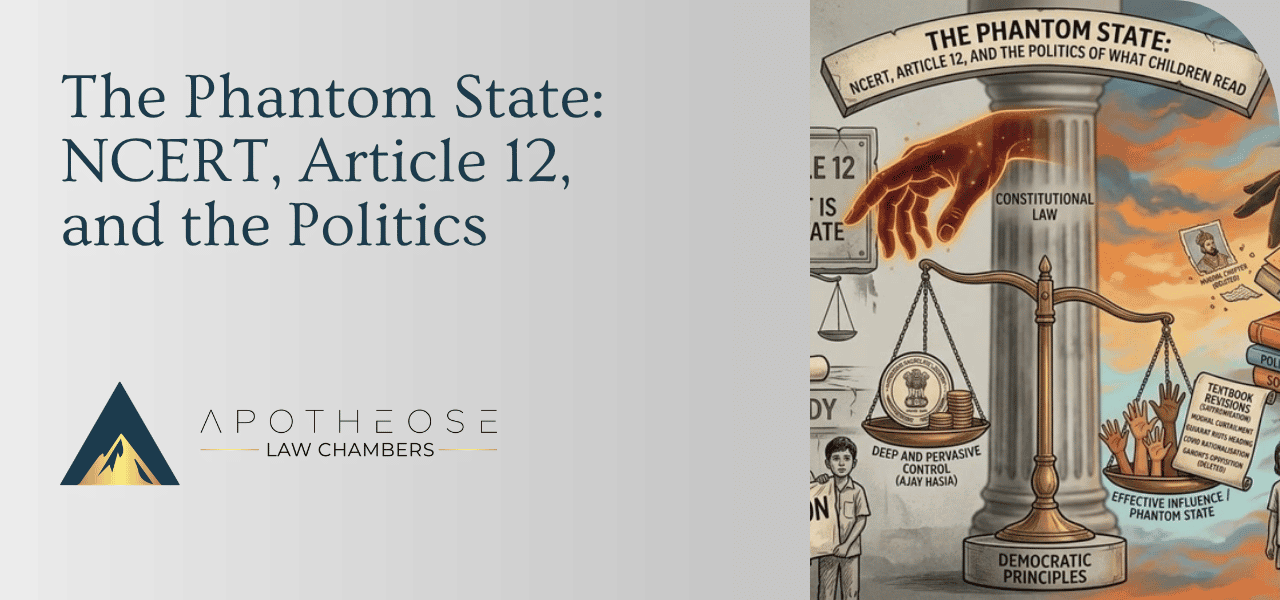
Let us return to Chander Mohan Khanna. The Supreme Court’s ruling that NCERT is not under “deep and pervasive” governmental control in the sense required to constitute it a State under Article 12. The Ajay Hasia tests were applied, and NCERT did not meet the threshold.
But constitutional law operates on a distinction that the real world does not always honour, i.e., the distinction between formal control and effective influence. NCERT’s autonomy is real enough as its Director General is not appointed by the Cabinet. Its textbooks are not approved by Parliament. No Ministry can, through a formal order, insert a paragraph or delete a chapter.
And yet, paragraphs are inserted. Chapters are deleted. Tones are changed. Titles are altered. The communal character of one massacre is retained in the text; the communal character of another is removed. The Mughal Empire shrinks. Sacred lands expand. Government schemes appear in Economics textbooks. The names of scholars are removed at their own request because they no longer recognise what was once their work.
All of this happens without a single legislative amendment, without a single government order that could be challenged in court, without a single provision of law that could be pointed to and said that ‘here is where the State exceeded its authority.’
This is the constitutional crisis that nobody is naming. India’s children have both the Right to Education under Article 21A and the implicit right, flowing from Article 19, to receive an education that is not an instrument of political propaganda. But the process through which NCERT shapes that education is designed to remain outside the reach of constitutional scrutiny. The body is formally autonomous. And the fact that those decisions track the ideological priorities of whichever party controls the central government is described as mere coincidence. Everytime.
The Deeper Stakes: Children as Citizens, Not Subjects
There is a distinction between the citizen and the subject. The subject is governed, whereas the citizen governs. The subject is told what to think; the citizen thinks for herself. The transition from colonial “praja” to independent “nagarik” was a promise that the people of India would not merely be administered but would participate, with full information and full freedom, in the administration of themselves.
That promise is quietly renegotiated every time a chapter is deleted or a community’s contribution is reduced to a footnote.
A microphone and three hours of political speech might sway a voter. But a textbook read from the age of ten to eighteen, used to construct a framework of understanding that the student will carry for the rest of her life. This does something more fundamental. It does not just persuade, but it builds the cognitive architecture within which persuasion later operates.
In Society for Unaided Private Schools of Rajasthan v. Union of India, the Supreme Court held that the Right to Education Act must be read in light of the constitutional values of equality, dignity, and non-discrimination. The right to education, thus, is not just a right of access to a school building, instead it is a right to an education that prepares the child for life as an equal citizen in a constitutional republic. An education that systematically distorts the historical record,, or curates the past to serve the political priorities fails that constitutional standard.
The question of NCERT’s legal status under Article 12 is the question of whether the State, which has been told to not directly violate the fundamental rights of children, has found a way to do so indirectly, through an autonomous body whose decisions consistently serve the ideological interests of the affiliations of any elected government.
The Phantom State
The law says NCERT is not a State; evidence says otherwise. The evidence says that a body whose textbooks expand coverage of Hindu philosophy when a Hindu nationalist party is in power, and contract such coverage when a centrist government returns, is not exercising autonomous educational judgment. It is performing political instruction with institutional plausible deniability. It is acting as an appendage, a phantom appendage, formally detached but functionally integrated.
The ghost of Chander Mohan Khanna judgement haunts the corridors of NCERT’s headquarters and the classrooms of Indian schools, telling contradictory stories at each location. India’s constitutional jurisprudence needs a framework for holding bodies like NCERT accountable for creating a substantive impact on the fundamental rights of the citizens they serve. Especially, on children who cannot vote, cannot litigate, cannot organise, and cannot refuse to read what they are given. The Right to Education means nothing if the education being provided is a tool of the government, and the information being given to children is curated to serve a political agenda rather than to develop an informed mind. A mic and long speech might not do what a deletion of a paragraph does. The deletion travels with the child for decades. It shapes what the child thinks, what the child believes, and what the child does not know that she does not know.
That is the power that NCERT exercises. And whether or not the Supreme Court calls it a State, the “citizens” who have become “subjects” already know whose instructions it follows.