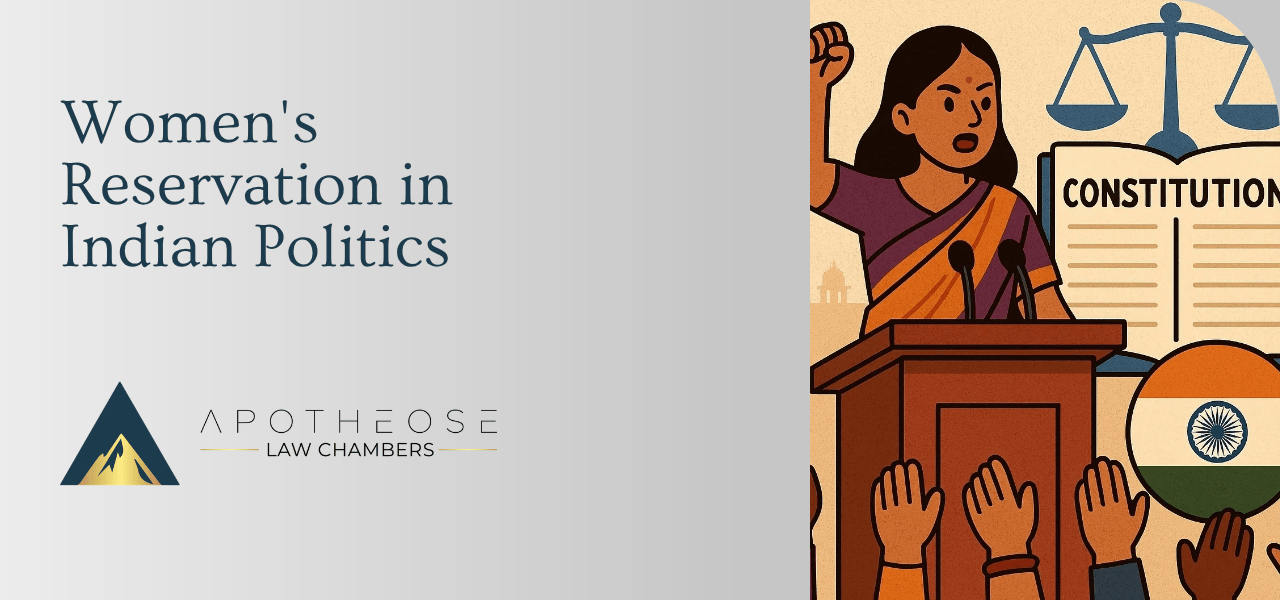
WOMEN’S RESERVATION IN INDIAN POLITICS: A CONSTITUTIONAL AND LEGAL PERSPECTIVE
Introduction: More Than Just a Policy
When Meena Kumari, a modest homemaker from Bihar, attended her first village Panchayat meeting, her voice quivered. Not from self-doubt, but from the weight of breaking age-old traditions. Her story mirrors the broader narrative of Indian women fighting to secure their legitimate place in the political arena. The reservation policy transcends mere statistics—it represents the emergence of voices that have remained silent for generations.
Historical Roots and Constitutional Promises
When India gained independence, its Constitution embedded a fundamental pledge: equality for everyone. Article 14 ensured legal equality, while Article 15 outlawed gender-based discrimination. Significantly, Article 15(3) empowered the State to create special provisions for women and children—establishing the foundation for positive discrimination.
However, women’s presence in the inaugural Lok Sabha of 1952 stood at a mere 5%. This figure reflected an inherent societal bias that viewed women primarily as voters rather than potential leaders.
Local Revolution: The 73rd and 74th Amendments
A significant transformation came in 1992 through the 73rd and 74th Constitutional Amendments, introducing Articles 243D and 243T. These amendments mandated one-third representation for women in Panchayati Raj institutions and urban local bodies.
This legislative change created opportunities for women like Priya Sharma, the corporate executive-turned-Sarpanch of Mehsana village in Gujarat. Her achievements motivated countless women to embrace governance roles—many breaking new grounds. Currently, several states have increased this reservation to 50%.
The Long Battle: Women’s Reservation Bill (1996–2023)
The Women’s Reservation Bill, introduced in 1996, proposed 33% reservation for women in Parliament and State Assemblies. For 27 years, it remained a testament to both aspirational change and political stalemate—repeatedly introduced, discussed, and postponed.
Eventually, in 2023, the 106th Constitutional Amendment Act was enacted, incorporating Articles 330A and 332A. This legislation guarantees one-third representation for women in the Lok Sabha and State Legislative Assemblies for 15 years.
Yet, the Act’s execution depends on the upcoming census and subsequent delimitation, potentially postponing its implementation until after 2029.
Constitutional and Legal Framework: A Pillar of Support
- Article 14: Establishes the fundamental right of equality before law.
- Article 15(3): Empowers special provisions for women, providing constitutional backing for reservation.
- Articles 243D & 243T: Establish mandatory women’s representation in local governance structures.
- Articles 330A & 332A (2023): Enshrine women’s reservation in parliamentary and state legislative bodies.
These constitutional provisions demonstrate a progressive evolution—from basic equality guarantees to concrete legislative mandates.
Judicial Interpretations: Courts as Champions
India’s judiciary has consistently supported and strengthened affirmative action policies and substantive equality:
- Indra Sawhney v. Union of India (1992): While primarily addressing caste-based reservations, this landmark judgment established affirmative action’s necessity for achieving genuine equality, validating reservation policies for underrepresented groups, particularly women.
- Union of India v. Rajendra N. Shah (2021): The Court emphasized the vital role of Panchayati Raj institutions, reinforcing the importance of grassroots-level representation.
- K. Krishnamurthy v. Union of India (2010): The Supreme Court validated the 73rd and 74th Amendments, declaring local body reservations essential for democratic participation.
These judicial pronouncements have cemented women’s reservation within India’s legal framework and democratic principles.
Grassroots Impact: Transforming Silent Observers into Active Leaders
Local-level reservations have revolutionized rural governance. In Bihar, women constitute approximately 50% of Panchayat representatives. Leaders like Rukmini Devi, a Dalit sarpanch from Madhya Pradesh, now manage village finances and interact with male officials—breaking barriers in traditionally patriarchal environments.
This transformation shows tangible results. Research indicates enhanced focus on essential services like water access, sanitation facilities, and educational initiatives in women-led areas. The Harvard Kennedy School’s 2012 research highlighted improved administrative efficiency in villages under women’s leadership.
Implementation Hurdles: Delayed Progress
While the 2023 Act marks a milestone, its execution depends on census completion and delimitation—potentially postponing implementation by five years. Critics label this delay as “justice postponed”, particularly given the census setbacks due to COVID-19.
The Act’s limitation regarding OBC women’s representation has sparked controversy. With reservation confined to SC and ST women within the one-third quota, backward caste communities demand broader inclusion.
Additionally, the “sarpanch-patis” phenomenon persists—where male family members control elected women representatives. While legislative frameworks provide opportunities, societal mindset transformation remains crucial.
Merit vs Reservation: Challenging Traditional Perspectives
Critics often pit merit against reservation. However, the fundamental question remains—can genuine meritocracy exist in a society marked by inherent inequalities?
As Justice Chandrachud articulated in Navtej Singh Johar v. Union of India (2018):
“The Constitution serves as a transformative instrument, designed to address and rectify historical marginalization and systemic exclusion.”
Reservation isn’t an antithesis to merit—rather, it establishes the fundamental groundwork that allows merit to thrive by creating equitable opportunities.
Global Comparisons: Insights from International Experience
- Rwanda: Demonstrates remarkable progress with women constituting over 60% of its Parliament, achieved through post-genocide constitutional provisions.
- Mexico: Has implemented comprehensive legislation ensuring gender parity in political nominations, guaranteeing balanced representation.
- Sweden, France, South Africa: Successfully employ combined approaches of legislative requirements and party-specific quotas, demonstrating that systemic transformation requires both political commitment and cultural acceptance.
India’s representation of 14% women in the 18th Lok Sabha positions it at 143rd globally, a concerning statistic for the world’s largest democratic nation.
Women as Voters: An Encouraging Development
A positive development emerges in women’s increasing electoral participation. The 2024 general elections witnessed women’s voter turnout marginally surpassing men’s, indicating readiness for both electoral participation and leadership roles.
Beyond Legislation: Political Party Responsibilities
Internal party democracy remains inadequate despite external reforms. Selection processes lack transparency, with women often allocated constituencies deemed “unwinnable.” Voluntary quota systems, similar to those in Germany and France, could enhance representation significantly.
Additionally, crucial aspects like political training, campaign financing, and security considerations require attention. Leadership development programs targeting aspiring women politicians—particularly from disadvantaged communities—are essential.
The Road Ahead: Achieving Meaningful Representation
1. Swift Implementation: Ensure the reservation materializes beyond legislative intent. Prioritize census completion and delimitation processes.
2. Comprehensive Quotas: Broaden reservation scope to encompass OBC and minority women, reflecting India’s diverse social composition.
3. Legislative Council Inclusion: Implement provisions across Rajya Sabha and State Legislative Councils for comprehensive representation.
4. Electoral and Party Reforms: Transform candidate selection processes and strengthen women’s political education.
5. Social Transformation: Implement awareness campaigns addressing tokenism and patriarchal mindsets.
Conclusion: Beginning a New Chapter
The journey from 1950’s constitutional guarantees to the 2023 Women’s Reservation Act represents persistent advocacy and determination. While legislation creates opportunities, genuine transformation requires women’s empowerment to utilize these platforms effectively.
As stakeholders in democracy, our responsibility extends beyond legislation to ensuring women’s meaningful participation and leadership.
Reflecting Justice Ruth Bader Ginsburg’s wisdom:
“Women belong in all places where decisions are being made.”
Our Constitution—vibrant, progressive, and deeply compassionate—embodies this eternal truth.