India is the largest democracy in the world embodied with it’s core principles of Constitution which guarantees equality, liberty and dignity to each and every citizen. Although Indian Constitution guarantees these rights the enforcement of these rights still remains a great challenge even after more than 78 years of Independence. One of the greatest challenge being police brutality standing out as one of the least talked about violation of the rights.
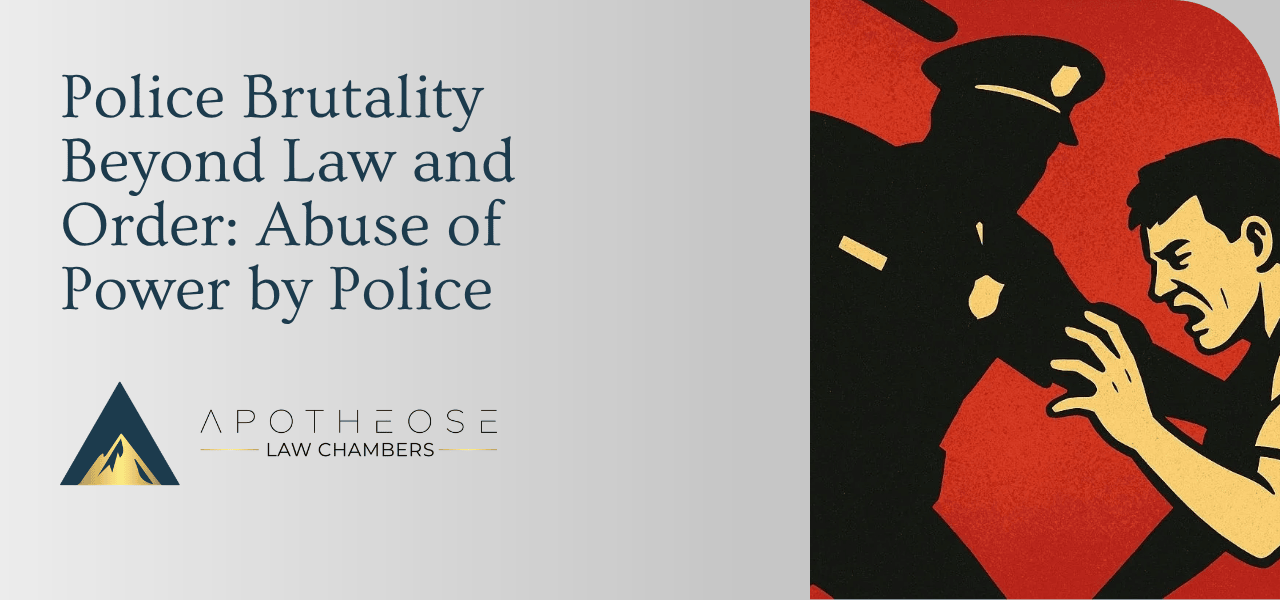
Police Brutality includes custodial torture, unlawful arrests, fake encounters, Illegal detention and so on . Such actions by the police who are considered to be our protectors not only weakens the trust of people in law enforcement bodies but also puts a big question mark on the civil rights that is guaranteed by our constitution under Articles 14,19,20,21 and 22. The Irony is deeply troubling, the very institution made to protect the people often comes across as the violator of their rights. From the death of civilians under custody to using force during the protests it is evident that police brutality is not a rare event but a recurring pattern that comes across as a major threat to Democracy and Civil Liberties.
Misuse of power by Police Authorities in day-to-day life
Police Brutality and Abuse of power is not limited to just physical like lathi charges, release of tear gas or custodial deaths, daily policing is a form of abuse of power as well and is deeply rooted in corruption that we get to see every day. For many citizens in the country, interaction with police begins and ends with demands of bribery it has become so common that people often consider it as the cost of getting basic procedures done.
Traffic rules violation is one of the most common example of bribery. Many police officers asks for bribes on the spot and let the violator go just for personal gain of mere Rs 500. For better understanding Let us take an example that almost everyone who drives a car has surely experienced. Imagine a person being stopped for over speeding and asked to produce his driving license. Unfortunately, he is not carrying it with him. Now, instead of issuing a challan as per the Motor Vehicles Act, the police officer hints through gestures that the matter can be ‘settled on the spot’ if a certain amount of money is paid. What should have been a lawful penalty under the Act thus turns into an act of corruption. This extends to lodging of FIR as well, according to section 154 CrPC and 173 BNSS Police officers asks for extra fee even before lodging an FIR which leads to common people fearing to even approach the police. Bail procedures are often misused as well the families of arrested person have to pay some extra amount off the records to ensure that the person in jail can be released early and ensure better treatment in custody as well. Such instances reveal how corruption affects the ordinary people and how corruption leads to exploitation of poor people and creates a system were justice is served to those who can afford it. These instances amount to failure of equal protection under Article 14 and right to live with dignity under article 21.
Police Brutality in Protests
In a Democracy , the right to peaceful assembly is provided under Article 19(1)(a)and (b) of the Indian Constitution which guarantees the citizens the freedom of speech ,expression and peaceful assembly but infringement of these rights every now and then is a great reminder of how fragile the implementation of the Civil rights in this nation are with images of people crying with torn clothes due to lathi charge and tear gas release in a protest makes a headline every other month in this country. This can be understood with more clarity by looking at these instances where police brutality caught media attention and caused outrage –
CAA-NRC Protests– during the protests the police barged into the university of Jamia Milia Islamia where students were met with tear gas and lathi charge.
Farmers Protests: The Delhi Police used barricades and water cannons and used lathis to prevent farmers from entering into Delhi and the Police became violent even when the farmers were pretesting peacefully.
All these instances not only weakens the trust of people in the Government but also puts a question on enforcement of fundamental rights.
Custodial Deaths and Torture: Unseen Reality of Law Enforcement
The term custodial death refers to the death of a person while being under the Custody of the Police, Judicial or other state agencies. Custodial death is a term that began circulating after World War II, when International Human Rights introduced framework such as Universal Declaration of Human Rights (1948) and later International Covenant on Civil and Political Rights which emphasized protection against arbitrary detention, torture and extrajudicial killings. Later on this term was widely recognised in the USA and UK during the Civil Rights Era 1960-1970.
Custodial Death is not a new concept in India as well cases of Custodial death have been taken into account since colonial Era when British Police used to torture inmates. After Independence the term started resurfacing in Parliament Debates. National Police Commission acknowledged presence of torture in custody as well. Finally in the case of DK Basu v State of West Bengal,(1997) 1 SCC 416 court laid down 11 key guidelines until parliament passed a law as produced below for reference
“36. We, therefore, consider it appropriate to issue the following requirements to be followed in all cases of arrest or detention till legal provisions are made in that behalf as preventive measures:
(1) The police personnel carrying out the arrest and handling the interrogation of the arrestee should bear accurate, visible and clear identification and name tags with their designations. The particulars of all such police personnel who handle interrogation of the arrestee must be recorded in a register.
(2) That the police officer carrying out the arrest of the arrestee shall prepare a memo of arrest at the time of arrest and such memo shall be attested by atleast one witness, who may be either a member of the family of the arrestee or a respectable person of the locality from where the arrest is made. It shall also be counter signed by the arrestee and shall contain the time and date of arrest.
(3) A person who has been arrested or detained and is being held in custody in a police station or interrogation center or other lock-up, shall be entitled to have one friend or relative or other person known to him or having interest in his welfare being informed, as soon as practicable, that he has been arrested and is being detained at the particular place, unless the attesting witness of the memo of arrest is himself such a friend or a relative of the arrestee.
(4) The time, place of arrest and venue of custody of an arrestee must be notified by the police where the next friend or relative of the arrestee lives outside the district or town through the Legal Aid Organisation in the District and the police station of the area concerned telegraphically within a period of 8 to 12 hours after the arrest.
(5) The person arrested must be made aware of this right to have someone informed of his arrest or detention as soon as he is put under arrest or is detained.
(6) An entry must be made in the diary at the place of detention regarding the arrest of the person which shall also disclose the name of the next friend of the person who has been informed of the arrest and the names and particulars of the police officials in whose custody the arrestee is.
(7) The arrestee should, where he so requests, be also examined at the time of his arrest and major and minor injuries, if any present on his/her body, must be recorded at that time. The “Inspection Memo” must be signed both by the arrestee and the police officer effecting the arrest and its copy provided to the arrestee.
(8) The arrestee should be subjected to medical examination by a trained doctor every 48 hours during his detention in custody by a doctor on the panel of approved doctors appointed by Director, Health Services of the concerned State or Union Territory. Director, Health Services should prepare such a penal for all Tehsils and Districts as well.
(9) Copies of all the documents including the memo of arrest, referred to above, should be sent to the illaqa Magistrate for his record.
(10) The arrestee may be permitted to meet his lawyer during interrogation, though not throughout the interrogation.
(11) A police control room should be provided at all district and state headquarters, where information regarding the arrest and the place of custody of the arrestee shall be communicated by the officer causing the arrest, within 12 hours of effecting the arrest and at the police control room it should be displayed on a conspicuous notice board.”
These guidelines laid down by the court marked a milestone in recognizing police brutality and helped us understand that police brutality is not a lapse of administration but also a direct violation of constitutional rights.
In the previous 5 years India has seen various cases of custodial death but only few gained public eye and media attention like Santhankulam Case 2020 Tamil Nadu, Ambasamudram Case 2023,Tamil Nadu, Sheikh Shadat Case (2023,Delhi ) , Tribal Youth Case(2024,Guna,MP) Ajith Kumar Case(2025, Tamil Nadu ) These are the few cases that got highlighted due to public eye but according to the NHRC from 2021-2022 total of 2,150 deaths in Judicial Custody and 155 in Police Custody was recorded but only 21% saw disciplinary Action.
The case of Santhankulam which sparked an outrage nationwide due do its horrific nature which took place in 2020 and in Tamil Nadu , In June 2020, during the Covid 19 lockdown Jayraj and his son J Bennix were arrested due to keeping their shops open for 15 minutes pass the permitted time of the lockdown they were then taken into the custody and were allegedly brutally tortured and assaulted by police officers and died within days of arrest .Witness reported that they sustained severe internal and external injuries due to which both of them scummed to their injuries . Initially, the police claimed the deaths were due to fever and complications In health later on Madras High Court Suo moto took cognizance of the case and the case was given to CBI for further investigation and in 2022 CBI filed chargesheet against 9 police personnel and charged them with Murder, wrongful confinement and other offences .This case not only highlighted the issues of custodial death in India but also showed that police brutality often comes hiding under the pretext of Law and Order.
Police Brutality and the Violation of the Golden Triangle
Golden Triangle is the back bone of Civil rights in India it comprises of Article 14,19,21 these are the main principles that are meant to ensure equality, freedom and dignity of each and every citizen and police brutality comes as a contradiction to those very rights meant to protect the normal citizens. Police often violates Article 14 (right to equality) i.e. equality before law and equal protection of laws which are infringed by the police when police acts with biasness with politicians or when they discriminate on the basis of caste or do racial profiling. Article 19 of the constitution that guarantees freedom of speech, expression peaceful assembly and movement Is infringed when police use excessive or third degree force during peaceful assemblies such as CAA NRC protests or Farmers protests. Custodial death or torture is a direct violation of article 21 of the constitution that guarantees right to live with dignity and personal liberty in the case of Joginder Kumar v. State of Uttar Pradesh,(1994)4 SCC 260 SC said power of arrest cannot be exercised arbitrarily and held that-
“ No arrest can be made because it is lawful for the Police Officer to do so. The existence of the power to arrest is one thing. The justification for the exercise of it is quite another. The police Officer must be able to justify the arrest apart from his power to do so. Arrest and detention in police lock-up of a person can cause incalculable harm to the reputation and self esteem of a person. No arrest can be made in a routine manner on a mere allegation of commission of an offence made against a person. It would be prudent for a Police Officer in the interest of protection of the constitutional rights of a citizen and perhaps in his own interest that no arrest should be made without a reasonable satisfaction reached after some investigation as to the genuineness and bonafides of a complaint and a reasonable belief both as to the person’s complicity and even so as to the need to effect arrest. Denying a person of his liberty is a serious matter.”
This judgement highlighted the misuse of police power and showed the gap between judicial pronouncements and ground reality.
Police Brutality and Law: Remedies available to citizens
It is not like that our legal system has not left us empty handed, it has given us remedies and protection against police brutality. Indian law provides framework, guidelines and networks to combat the problem of Police Brutality, from constitutional guarantees to criminal laws to human rights there are several remedies that exits to uphold the rights of citizens let’s discuss the remedies one by one-
Starting with the Constitution of India, it provides Golden Triangle as discussed earlier, Article 15, Article 19 and Article 21 makes the foundation of all legislations and marks arbitrary police action unconstitutional.
In Criminal Law the Indian Penal Code /BNS specifically criminalizes acts of police brutality-
1. Section 166 IPC / Section 218 BNS – Public servant disobeying law with intent to cause injury.
2. Section 330 & 331 IPC / Section 184 & 185 BNS – Voluntarily causing hurt or grievous hurt to extort confession
3. Section 348 IPC / Section 187 BNS – Wrongful confinement to extort confession.
4. Section 302 IPC / Section 101 BNS – Custodial death amounts to murder.
5. Section 376(2)(b) IPC / Section 64(2)(b) BNS – Protection against custodial rape by a public servant ensuring accountability in case of sexual violence in custody.
In CrPC/BNSS procedural safeguards are provided under Section
1. Section 46 CrPC / Section 35 BNSS – Mode of arrest; no more force than necessary should be used.
2. Section 49 CrPC / Section 37 BNSS – No more restraint than necessary during arrest.
3. Section 50 CrPC / Section 48 BNSS – Right of arrested person to know the grounds of arrest.
4. Section 54 CrPC / Section 53 BNSS – Medical examination of the accused on request.
5. Section 176(1A) CrPC / Section 198(1) BNSS – Judicial inquiry mandatory in case of custodial death, rape, or disappearance.
Further the cases of custodial deaths are investigated by statutory bodies like NHRC ( National Human Rights) Commission and SHRC (State Human Rights Commission) investigates all the cases of custodial deaths and any custodial death taking place within the country must be reported to the commission within 24 hours and provides compensation a person can directly file a complaint under NHRC if they are subjected to police brutality custodial death or illegal detention.
All these provisions acts as remedies against police brutality and ensure when a police officer/public servant goes against a law, the victim has legal remedies to seek justice.
Conclusion
Police are the protector of the citizens and uphold the law, but instances of brutality and misuse of power weaken public trust in the legal system. While cases like D.K. Basu v. State of West Bengal and Joginder Kumar v. State of U.P. laid down safeguards, and legislations such as the IPC/BNS, BNSS, CrPC, and Human Rights laws provide remedies but the gap often lies in implementation. It is important for individuals to know their rights, demand accountability, and use the legal and human rights framework available to them. Real change can only be made with not just legal safeguards but also strict enforcement, police training, and a cultural shift towards transparency and respect for human dignity. Only then can the balance between authority and accountability truly be achieved.