UNDERSTANDING THE SLOW PACE OF THE INDIAN JUDICIAL SYSTEM
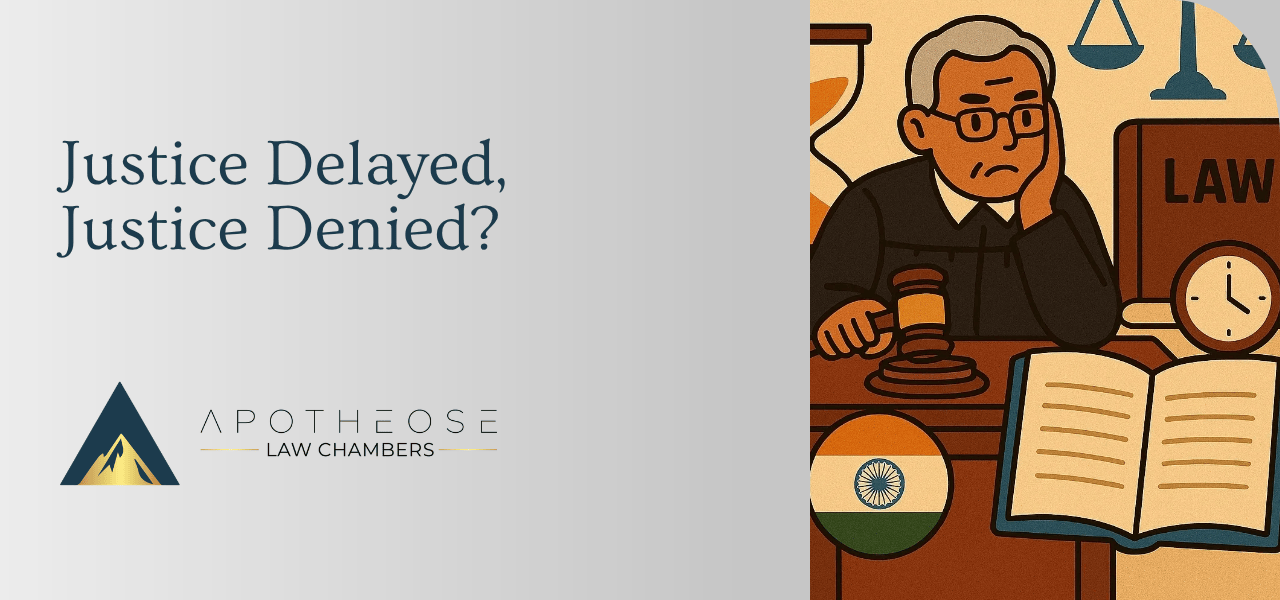
“Justice delayed is justice denied.” This oft-quoted maxim resonates deeply in the Indian context, where the wheels of justice often turn at a glacial pace. For millions of litigants, the journey through India’s courts is not just a legal process but a test of patience, endurance, and sometimes, hope itself. Yet, the story of judicial delay in India is not one of simple inefficiency or neglect. It is a complex narrative woven from historical legacies, structural challenges, and evolving reforms. This article explores why the Indian judicial system is slow, examines both its strengths and weaknesses, and highlights landmark cases that have shaped the discourse on judicial delays.
The Magnitude of the Problem: A Statistical Snapshot
To appreciate the scale of judicial delays in India, one must first confront the numbers:
Over 5 crore (50 million) cases are pending at various levels of the judiciary as of June 2024. Of these, a staggering 87% are stuck in subordinate courts, while 12% await resolution in High Courts.
In High Courts, nearly 75% of cases have been pending for over a year. In lower courts, this figure stands at 63%.
The Supreme Court itself, the apex of the Indian judiciary, had over 82,000 pending cases as of March 2024, with civil matters constituting 79% and criminal cases 21%. These numbers are not just statistics; they represent real people waiting for justice, whether it’s a family fighting for property, a business waiting for a contract dispute to be settled, or someone accused of a crime hoping to clear their name.
Why Is the Indian Judicial System So Slow?
1. Structural Causes: The Foundation of Delay
a. Severe Judicial Vacancies
India’s judge-to-population ratio is alarmingly low; about 20 judges per million people, far below the recommended 50 per million. High Courts have more than 30% of posts unfilled, and district courts face over 5,000 vacancies. This chronic shortage means each judge is burdened with an overwhelming caseload, making timely justice a distant dream.
b. Procedural Complexities and Outdated Laws
The Indian legal system is still shackled by colonial-era laws and procedures. The Code of Civil Procedure (CPC) and Code of Criminal Procedure (CrPC), while amended over the years, still allow for multiple appeals, reviews, and adjournments. These rules, while meant to protect fairness, often make cases drag on for years.
c. Culture of Adjournments
Adjournments or postponements of hearings are granted with alarming frequency. Despite amendments to curb this practice, adjournments are often given for reasons as trivial as a lawyer’s absence or the need for further instructions. This culture, sometimes exploited by parties to delay proceedings, is a major contributor to the backlog.
d. Inadequate Infrastructure
Many courts operate in dilapidated buildings with insufficient staff and outdated technology. Cramped courtrooms, lack of digital facilities, and poor record-keeping further slowdown the process.
e. Government as the Biggest Litigant
The government is involved in nearly half of all court cases, either as a party or because of appeals against its decisions. Bureaucratic delays in decision-making and representation add to the judicial burden.
f. Legislative Proliferation
The constant expansion of laws, often poorly drafted, leads to interpretational disputes and more litigation, further clogging the courts.
2. The Human Cost: Stories Behind the Numbers
Every delayed case is a personal story. Imagine a widow waiting for compensation, a person wrongly accused of a crime sitting in jail, or a business owner unable to move forward because of a pending dispute. Delays cause stress, financial loss, and sometimes even ruin lives. People lose faith in the system, and some turn to illegal ways to solve their problems.
Why the System Deserves Some Sympathy
While the criticisms are valid, it is important to recognize the genuine challenges and positive aspects of the Indian judicial system.
1. Sheer Volume and Diversity
India is the world’s largest democracy, with a population of over 1.4 billion. The diversity of languages, cultures, and legal issues is unparalleled. The judiciary is tasked with resolving disputes ranging from petty theft to complex constitutional questions, often with limited resources.
2. Safeguarding Rights and Due Process
The Indian judiciary is deeply committed to upholding the principles of natural justice and due process. Unlike some countries where summary trials are common, Indian courts ensure that every party gets a fair hearing, which, while time-consuming, is essential for justice.
3. Judicial Activism and Social Justice
The Supreme Court and High Courts have played a transformative role in expanding rights and addressing social injustices. Landmark judgments on environmental protection, gender equality, and civil liberties have often come through Public Interest Litigations (PILs), which, though adding to the caseload, are important for society.
4. Comparative Perspective
Judicial delays are not unique to India. Even advanced countries like the United States and the United Kingdom grapple with backlogs and delays, especially in complex or high-profile cases. The difference lies in the scale and the limited resources available in India.
Recent Reforms and Positive Initiatives
Recognizing the crisis, the Indian government and judiciary have launched several reforms:
1. Centrally Sponsored Scheme (CSS) for Judicial Infrastructure
With a financial outlay of Rs. 9000 crores, this scheme aims to modernize court infrastructure, including digital facilities, lawyers’ halls, and better amenities for litigants and staff.
2. e-Courts Project
The e-Courts Mission Mode Project is digitizing court records, enabling e-filing, and facilitating virtual hearings. The goal is to make the system paperless and more efficient.
3. Filling Judicial Vacancies
Between 2014 and 2024, 62 judges were appointed to the Supreme Court and 976 to High Courts, a significant step towards reducing vacancies.
4. Alternative Dispute Resolution (ADR)
Mediation, arbitration, and Lok Adalats are being promoted to resolve disputes outside the traditional court system, reducing the burden on regular courts.
5. Technological Advancements
Virtual courts, e-filing, and the National Judicial Data Grid (NJDG) have improved transparency and efficiency.
Expert Recommendations: The Road Ahead
- Legal scholars and practitioners have proposed several measures to further improve judicial efficiency:
- Increase Judicial Strength: Appoint more judges and support staff, and ensure timely filling of vacancies.
- Improve Infrastructure: Invest in modern courtrooms, digital facilities, and residential accommodations for judges.
- Administrative Reforms: Delegate administrative tasks to specialized agencies, freeing judges to focus on adjudication.
- Case Management Systems: Use technology to track cases and avoid unnecessary delays.
- Better Financial Management: Ensure that the courts have enough money to function properly.
The Negative Side: When the System Fails
- Despite reforms, the problems are still serious:
- Endless Waits: Some people wait decades for their cases to end. Evidence gets lost, memories fade, and sometimes the parties involved die before the case is over.
- Erosion of Trust: Delays make people lose faith in the courts and sometimes turn to illegal ways to solve disputes.
- Economic Impact: Businesses suffer due to unresolved commercial disputes, affecting investment and economic growth.
- Vulnerable Groups Suffer Most: The poor, marginalized, and underprivileged are disproportionately affected, as they lack the resources to navigate prolonged litigation.
Landmark Case Laws
1. The Calcutta Civil Case of 1833
Perhaps the most extreme example of judicial delay, this case remained unresolved for over a century, becoming a symbol of the system’s lethargy.
2. All India Judges Association v. Union of India (1992)
In this landmark case, the Supreme Court itself acknowledged the need for more judges and better infrastructure to tackle the backlog and directed the government to increase the number of judges and improve service conditions, recognizing the link between judicial strength and timely justice.
3. Hussainara Khatoon v. State of Bihar (1979)
This famous case revealed that thousands of undertrial prisoners were stuck in jail for years without a trial. The Supreme Court said that a speedy trial is a fundamental right under Article 21 of the Constitution. This case forced the courts to look at how delays hurt the most vulnerable people.
4. Imtiyaz Ahmad v. State of Uttar Pradesh (2012)
Here, the Supreme Court asked for a scientific study to figure out how many judges are needed to clear the backlog and deliver justice on time.
4. Common Cause v. Union of India (1996)
The Court emphasized the need to dispose of cases within a reasonable time and directed the government to take steps to reduce pendency.
Comparative Context: How Does India Fare Globally?
India’s judicial delays are not unique. The United States, for example, has seen death row inmates wait decades for their appeals to be heard, raising questions about the effectiveness of the system. The Crown Court in England and Wales has faced record backlogs, affecting
victims and the quality of justice. What sets India apart is the sheer scale of the problem and the resource constraints faced by its judiciary.
Conclusion: Towards a Faster, Fairer Justice System
The slow pace of the Indian judicial system is a product of historical legacies, structural challenges, and the sheer complexity of administering justice in a vast and diverse country. While the system has its flaws; delays, adjournments, and infrastructural deficits, it also embodies a deep commitment to fairness, due process, and social justice. Reforms are underway, and there is a growing recognition of the need for change. Yet, true transformation will require sustained investment, political will, and a cultural shift towards efficiency and accountability. For the millions waiting for justice, every day counts. As India marches towards its future, ensuring timely justice is not just a legal imperative but a moral one.
This article is dedicated to the countless litigants whose faith in justice endures, even when the wait seems endless. May their patience not be in vain, and may the promise of justice be fulfilled in their lifetimes.