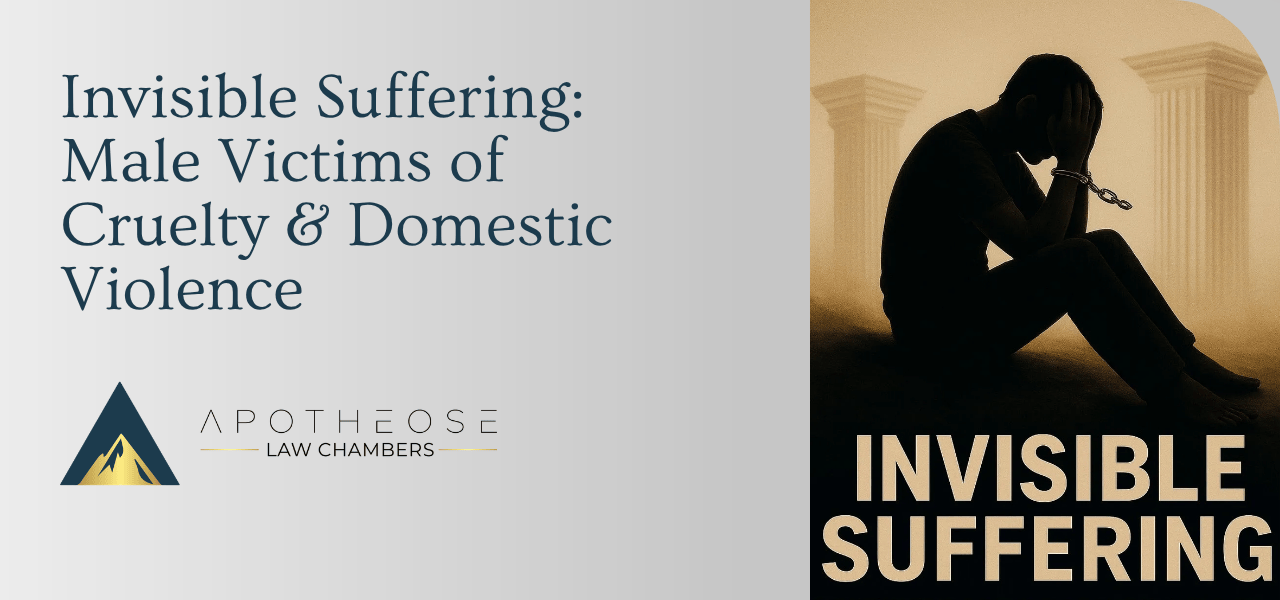
Understanding Male Victimization in Domestic Violence:
The term “Victimization” though not defined explicitly under various legal codes within a single terminology. It is a very serious issue that needs to be addressed which has legal as well as social implications over the concerned person as well as on society.
In recent times, victimization of men has become very common which can be inferred through the rising number of the cases being registered on daily basis. Victimization has become such a common word in our day-to-day life that the society has started taking it as casual parts of their life, but no one truly knows the hardship a person has to face after being victimized—the insults, societal pressure, and many more struggles, but when the situation occurs of male victimization, the hardships often go unacknowledged. Despite being core members of society, they remain unheard and are denied recognition as victims due to deep-rooted history, stereotypes, and societal expectations.
While laws and cultural narratives have been focusing on the protection of the women – which is undoubtedly right due to the past experiences, but has unintentionally created a void around those men who are suffering from the same dilemma. When any kind of the instances occur with men the society is not being considerate with them as they are the ones who are portrayed as perpetrators of the community and not as the victims. The legal system also recognizes victimization with men in only selected verses, leaving them with no other remedies. The combination of the societal norms and the legal gaps have been the major reason for making the suffering of the men invisible.
Example: Arun, a young banker, was falsely accused of domestic violence by his wife after he refused to transfer property in her name. Though innocent, he was arrested, suspended from his job, and shamed by society. Even after being cleared in court, the emotional trauma and damage to his reputation stayed with him.
Unveiling the Struggles of Male Victims:
If the words like domestic violence or cruelty pops up under any conversation the first thing that strikes in the minds is any women must be suffering or the victim must be a woman. However, men can also be sufferers of such heinous crimes such as emotional, physical, and financial abuse within relationships, whereas societal stigma has discouraged them from coming forward and explaining the torture they face.
Male victimization is often brushed aside because society has long believed that men must always be strong, dominant, and unshaken. These stereotypes leave little room for men to show their pain or admit vulnerability. As a result, many suffer quietly, with hardly any legal recognition or support systems to help them through their struggles. On top of this, issues like false allegations, unfair alimony, and the denial of an equal standard of living after separation only deepen their hardships. Recognizing that men, too, can be victims is not about taking away from anyone else’s struggles—it is about building a fairer and more compassionate justice system that protects every individual, no matter their gender.
Male and Female are the two wheels of the same cart i.e. Society. But in recent times it is a matter of an in – depth discussion that what are the root cause for such increase in the gender-based violence. With passage of time and changing dimensions of the societal set up may lead to increasing violence against men. The socio- cultural and psychological factors plays a vital role in violence against men in domestic set up. Study indicates that certain social conditions may increase the risk of increasing violence against men. Unmet financial expectations of women and anger management or work – related stress may displace their frustration through verbal or physical aggression, not only this but the legal framework also played its role really well as no dedicated legal framework for men leads to misuse of rights provided to women and most domestic violence law are exclusively tailored in a way which backs women, considering them as the sole victims. Domestic Violence may not be grave but it leaves a lasting harm in both visible and invisible ways. Men are already in a vulnerable stage due to familial and societal pressure. Being a part of the patriarchal society, a man is always associated with strength and dominance which later on push them to live in an abused and cruel environment created by women rather disclosing their victimization as they find it humiliating to disclose and admit that they are being abused by a woman. Therefore, it is the need of the hour that we start considering men as a normal human being with emotions and feeling and take a step forward to advocate the reforms in legal framework and took a multi faced approach to deal with this menace.
Indian Legal Framework:
Misuse of Gender-Specific Laws:
Section 498A Of Indian Penal Code, 1860 [REPEALED] – Husband or relative of husband of a woman subjecting her to cruelty
“Whoever, being the husband or the relative of the husband of a woman, subjects such woman to cruelty shall be punished with imprisonment for a term which may extend to three years and shall also be liable to fine.
Explanation. –For the purpose of this section, “cruelty” means–
(a) any wilful conduct which is of such a nature as is likely to drive the woman to commit suicide or to cause grave injury or danger to life, limb or health (whether mental or physical) of the woman; or
(b) harassment of the woman where such harassment is with a view to coercing her or any person related to her to meet any unlawful demand for any properly or valuable security or is on account of failure by her or any person related to her to meet such demand.]”
Section 85 of Bhartiya Nyaya Sanhita, 2023 – Husband or relative of husband of a woman subjecting her to cruelty
“Whoever, being the husband or the relative of the husband of a woman, subjects such woman to cruelty shall be punished with imprisonment for a term which may extend to three years and shall also be liable to fine.”
Alimony and Maintenance Bias:
Section 125 of Criminal Procedure Code, 1973- Order for maintenance of wives, children and parents
“The certain section states that who all can claim to maintenance for themselves if they are unable to maintain themselves. The person who can be considered as dependents are wife (even if divorced, provided she had not remarried), legitimate or illegitimate minor children (married or unmarried) unable to maintain themselves, adult children suffering from physical or mental disabilities, and father or mother unable to maintain themselves. A minor married daughter could also claim maintenance from her father if her husband lacked sufficient means.
The Magistrate has the authority to grant interim maintenance and proceeding expenses as well i.e. payable from the date of application or date of order. If there is non-compliance, Magistrate has the authority to issue warrant for recovery of the amount now imposed as a fine, and even sentence the wrongdoer for imprisonment up to 1month for every single default.”
Section 36 of Special Marriage Act, 1954 – Alimony pendente life
“Where in any proceeding under Chapter V or Chapter VI it appears to the district court that the wife has no independent income sufficient for her support and the necessary expenses of the proceeding, it may, on the application of the wife, order the husband to pay to her the expenses of the proceeding, and weekly or monthly during the proceeding such sum as having regard to the husband’s income, it may seem to the court to be reasonable.
[Provided that the application for the payment of the expenses of the proceeding and such weekly or monthly sum during the proceeding under Chapter V or Chapter VI, shall, as far as possible, be disposed of within sixty days from the date of service of notice on the husband.]”
Section 37 of Special Marriage Act, 1954 – Permanent alimony and maintenance
“(1) Any court exercising jurisdiction under Chapter V or Chapter VI may, at the time of passing any decree or at any time subsequent to the decree, on application made to it for the purpose, order that the husband shall secure to the wife for her maintenance and support, if necessary, by a charge on the husband’s property such gross sum or such monthly or periodical payment of money for a term not exceeding her life, as, having regard to her own property, if any, her husband’s property and ability1 [the conduct of the parties and other circumstances of the case], it may seem to the court to be just.
(2) If the district court is satisfied that there is a change in the circumstances of either party at any time after it has made an order under sub-section (1), it may, at the instance of either party, vary, modify or rescind any such order in such manner as it may seem to the court to be just.
(3) If the district court is satisfied that the wife in whose favour an order has been made under this section has re-married or is not leading a chaste life,2 [it may, at the instance of the husband vary, modify or rescind any such order and in such manner as the court may deem just.]”
These legislations clearly depict that laws are extremely biased towards the women. While these were necessary at the time of their creation because of the vulnerable position of the women, while at present the situation has changed. Hence, there is a pressing need to amend the current legislation to ensure true equality between men and women, while maintaining the balance of justice and acknowledging women as a vulnerable class so that women do not dare to misuse the law just for their whims and fancies without giving a thought about the other person.
There have been various instances in the past where women have falsely accused men of acts that never occurred. Due to the existing legislation, the men suffered for years, and although they were eventually acquitted, it came only after prolonged hardships. Some such cases are described below:
Atul Subash Case:
In this famous case the ‘Atul Subash’ 34-year-old AI professional, working in Bangalore tragically ended his life by hanging himself. The reason behind taking of such a crucial step was derived from his death sentence or in this case we could say ‘Death Video’ in which he stated the battle he facing due to the legal loopholes or which could be refried as biased legislation, which favours only the women by directly imposing men as the criminals.
In the particular note he referred to the false complaints lodged under section 498A of Indian Penal Code, 1860, financial extortion and even cruelty that she inflicted upon him. The words in the note inflicted that he felt himself to be trapped, considered himself to be a branded criminal and cherry on the top in this case was that he was even denied to meet his own son. He was pushed to brink by relentless harassment which led him to take this unholy step. The Supreme Court on the other hand stated that mere harassment, without any clear proof of intent, does not constitute abetment to suicide.
This case exposed a critical blind spot: while anti-dowry and cruelty laws were enacted to protect women, their misuse can inflict untold suffering on men—often without legal safeguards or avenues for recognition
Sushil Kumar Sharma vs. Union of India (UOI) and Ors. (19.07.2005 – SC): MANU/SC/0418/2005
“The object of the provision is prevention of the dowry menace. But as has been rightly contented by the petitioner many instances have come to light where the complaints are not Bonafide and have been filed with oblique motive. In such cases acquittal of the accused does not in all cases wipe out the anomy suffered during and prior to trial. Sometimes adverse media coverage adds to the misery. The question, therefore, is what remedial measures can be taken to prevent abuse of the well-intentioned provision. Merely because the provision is constitutional and intra vires, does not give a license to unscrupulous persons to wreck personal vendetta or unleash harassment. It may, therefore, become necessary for the legislature to find out ways how the makers of frivolous complaints or allegations can be appropriately dealt with. Till then the Courts have to take care of the situation within the existing frame work. As noted above the object is to strike at the roots of dowry menace. But by misuse of the provision a new legal terrorism can be unleashed. The provision is intended to be used a shield and not an assassin’s weapon. If cry of “wolf” is made too often as a prank assistant and protection may not be available when the actual “wolf” appears. There is no question of investigating agency and Courts casually dealing with the allegations. They cannot follow any straitjacket formula in the matters relating to dowry tortures, deaths and cruelty. It cannot be lost sight of that ultimate objective of every legal system is to arrive at truth, punish the guilty and protect the innocent. There is no scope for any pre-conceived notion or view. It is strenuously argued by the petitioner that the investigating agencies and the courts start with the presumptions that the accused persons are guilty and that the complainant is speaking the truth. This is too wide available and generalized statement. Certain statutory presumptions are drawn which again are rebuttable. It is to be noted that the role of the investigating agencies and the courts is that of watch dog and not of a bloodhound. It should be their effort to see that an innocent person is not made to suffer on account of unfounded, baseless and malicious allegations. It is equally undisputable that in many cases no direct evidence is available and the courts have to act on circumstantial evidence. While dealing with such cases, the law laid down relating to circumstantial evidence has to be kept in view. “
In this particular case the Supreme Court acknowledge the fact of misuse of the law and stated that just because the law is valid and constitutional doesn’t mean it should be used by dishonest persons just for taking revenge or threaten others. The legislature may need to find ways to punish those who file false complaints. In addition to it addressed that it is the duty of the courts to find the real truth, punish the guilty, and protect the innocent.
Johnny Depp Case:
The famous case of Johnny Depp v. Amber heard turned out to be the most widely discussed trials of all times. Johnny filed a defamation case against Heard (ex-wife) that she was a victim of domestic abuse. Even though she never stated any name in her statement but as her ex-husband it indirectly pointed out to be him, which led to loss of his reputation among the society as well as towards his career.
The things that made it worldwide famous trial was the evidence Depp brought forward. The evidence not only pointed him to be innocent but imprinted Heard to be the one who has falsely accused him of acts that he was facing rather than of committing them. The witness and recordings were the proofs that showed the other side of the story which the world hates to accept that “Men could also be the victims”. The trial showed that he was a victim of physical violence, insults, and constant belittlement.
For Depp it was not just a fight to clear his name out or his reputation but also to show the society that how male victims are often ignored and mocked because of gender stereotypes. In the end Jury sided with Jhonny Depp stating the allegations put by Amber heard to be as false accusations and awarding him damages.
Few Provisions Men Can Rely on for Protection:
Section 211 Of Indian Penal Code, 1860 – False charge of offence made with intent to injure
“Whoever, with intent to cause injury to any person, institutes or causes to be instituted any criminal proceeding against that person, or falsely charges any person with having committed an offence, knowing that there is no just or lawful ground for such proceeding or charge against that person, shall be punished with imprisonment of either description for a term which may extend to two years, or with fine, or with both;
and if such criminal proceeding be instituted on a false charge of an offence punishable with death, 1[imprisonment for life], or imprisonment for seven years or upwards, shall be punishable with imprisonment of either description for a term which may extend to seven years, and shall also be liable to fine.”
Section 306 Of Indian Penal Code, 1860 – Abetment of suicide
“If any person commits suicide, whoever abets the commission of such suicide, shall be punished with imprisonment of either description for a term which may extend to ten years, and shall also be liable to fine.”
Section 323 Of Indian Penal Code, 1860 – Punishment for voluntarily causing hurt
“Whoever, except in the case provided for by section 334, voluntarily causes hurt, shall be punished with imprisonment of either description for a term which may extend to one year, or with fine which may extend to one thousand rupees, or with both.”
Section 438 Of Criminal Procedure Code, 1973 – Direction for grant of bail to person apprehending arrest
“(1) Where any person has reason to believe that he may be arrested on accusation of having committed a non-bailable offence, he may apply to the High Court or the Court of Session for a direction under this section that in the event of such arrest he shall be released on bail”
The certain provision helps a person who has an apprehension of getting arrested on the ground of a wrong accusation of committing a non-bailable offence, to prevent them from getting arrested. And if arrested, they may be released on bail.
Section 499 Of Indian Penal Code, 1860 – Defamation
“Whoever, by words either spoken or intended to be read, or by signs or by visible representations, makes or publishes any imputation concerning any person intending to harm, or knowing or having reason to believe that such imputation will harm, the reputation of such person, is said, except in the cases hereinafter expected, to defame that person.”
Conclusion:
Male victimization or Male sufferings in domestic violence as well as in cruelty cases continues to be a struggle that remains to be unseen or considered to be invisible, hidden behind the legal loop holes and societal stereotypes. While the law is persistently focused on protecting women due to their historical vulnerability, has led to one sided framework against the men leaving limited avenues for their justice.
The societal narratives such as “Men must be strong”, “Men don’t cry” not only silence their suffering but worsen the pain they have been enduring. The tragic miss happening of individuals such as Atul Subhash bound us to rethink the societal norms the breaking of the silence on such narratives. Hence, it is now a matter of great importance that the thinking of people must need to be change that power and control come with the physical strength and through a specific gender. It is the need of the hour to raise awareness that anyone can become victim regardless of their gender.
Recognizing male victimization is not actually shifting the focus from the women to the men or just focusing over men but is actually about addressing as well as embracing a fairer and more effective version of justice – where one is not judged or ignored on the basis of their gender but promotes equality. For truly attaining that position, we must remove the deep-rooted stigma with empathy and meaningful legal reforms.
Law should serve as a balanced mechanism of protection for all individuals rather not become a tool for revenge or coercion. Our legal framework and Government must come along to introduce gender-neutral legislation in the nation that not only deals with violence, cruelty or harassment but also keep a check upon the false accusations, financial abuse, verbal degradation as well as emotional and financial manipulation by women against men. Therefore, as society and family dynamics evolve, a balanced, equitable legal framework which talks and acknowledges the rights and vulnerabilities of both men and women is essential for building a just and civilized society.