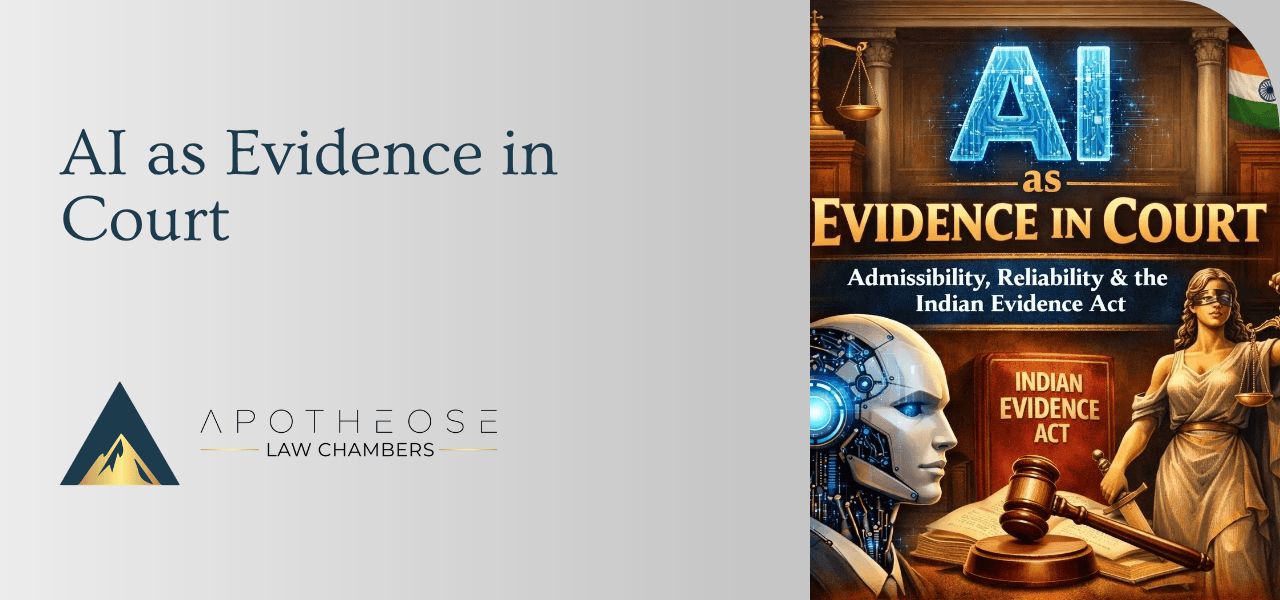
AI as Evidence in Court: Admissibility, Reliability & the Indian Evidence Act
Abstract
The use of Artificial Intelligence (AI) in criminal investigations and court proceedings is steadily increasing. Technologies such as facial recognition, voice analysis, surveillance tools, predictive systems, and automated document examination are now commonly used to collect and analyse evidence. While these tools can make investigations faster and more efficient, their use as evidence in courts raises serious legal and constitutional concerns.
This article examines how AI-generated evidence fits within the existing framework of the Indian Evidence Act, 1872 and the Bharatiya Sakshya Adhiniyam, 2023, along with the Information Technology Act, 2000. It explores whether AI-based material meets basic legal requirements such as admissibility, reliability, and authenticity. The article highlights major risks associated with AI evidence, including bias in algorithms, lack of transparency in how decisions are made, and over-reliance on technology.
Special attention is given to growing threats like deepfake videos, AI-edited documents, and voice cloning, which make it difficult to determine whether digital evidence is genuine or has been manipulated. These developments seriously challenge traditional ideas of proof, chain of custody, and forensic verification, and increase the risk of false or misleading evidence being used in court.
The article also discusses the impact of AI evidence on fundamental rights, particularly the right to equality, protection against self-incrimination, and the right to a fair trial under the Constitution of India. It concludes that although Indian evidence law recognises electronic records, it is not fully prepared to deal with the unique problems posed by AI-generated evidence. The article stresses the need for careful judicial scrutiny, expert involvement, and clear legal guidelines to ensure that AI supports justice rather than undermines it.
Introduction
Evidence is the foundation upon which courts determine truth, guilt, and liability. Every judicial decision whether in civil disputes or criminal trials, ultimately depends on the quality, reliability, and admissibility of evidence placed before the court. Under Section 3 of the Indian Evidence Act, 1872, evidence traditionally includes oral statements made before the court and documents produced for its inspection. For decades, this understanding was limited to physical documents and human testimony. However, with the expansion of digital communication, courts increasingly encounter electronic records such as emails, call data records, CCTV footage, and digital files.
Recognising this transformation, Indian evidence law gradually evolved to include electronic records within the definition of documentary evidence. Judicial interpretation and statutory amendments led to the inclusion of electronic records under Section 65B of the Indian Evidence Act, which prescribes conditions for admissibility of electronic evidence. This position has now been strengthened under the Bharatiya Sakshya Adhiniyam, 2023, which expressly recognises electronic and digital records as documents, thereby modernising the evidentiary framework to suit the digital age.
This evolution reflects the law’s attempt to balance technological progress with procedural safeguards, ensuring that digital evidence is admitted only when its authenticity and integrity are established.
Emergence of Artificial Intelligence in the Judicial Process
Artificial Intelligence marks a further shift beyond conventional electronic evidence. Unlike ordinary digital records, AI systems actively analyse data and generate outputs through algorithms. These outputs may include facial recognition matches, voice identification results, automated document analysis, or predictive assessments.
In evidentiary terms, AI-generated material is presented as an electronic record and must comply with the statutory requirements governing such evidence. Under the Indian Evidence Act and the BSA, AI outputs fall within the scope of documentary and electronic evidence and are subject to authentication and certification requirements similar to those under Section 65B. Further, when technical or scientific opinions are involved, courts rely on Section 45 of the Indian Evidence Act and the corresponding provision under the BSA, which allow expert evidence to explain scientific processes and technical analysis.
However, unlike traditional electronic records, AI evidence introduces an additional layer of complexity. The output is not a direct human record but the result of automated reasoning based on data, training models, and programmed assumptions. This raises important questions about reliability, human accountability, and the extent to which courts can scrutinize such evidence using existing legal tools.
Need for Legal Scrutiny of AI-Generated Evidence
The increasing use of AI-generated evidence demands heightened legal scrutiny under established evidentiary principles. Under Sections 5 and 136 of the Indian Evidence Act and their equivalents under the BSA, courts must ensure that evidence is not only relevant but also legally admissible. AI evidence, therefore, must satisfy tests of relevance, authenticity, and reliability before it can be relied upon.
Technological developments such as deepfake videos, AI-edited documents, and voice cloning pose serious challenges to the authenticity of electronic evidence. These risks directly impact the requirement of proving that a document or electronic record is genuine and untampered. If AI-generated material is admitted without strict verification, it may violate procedural safeguards and undermine the fairness of the trial process.
Additionally, the inability to fully explain or challenge AI decision-making processes can affect the accused’s right to a fair trial, protected under constitutional principles and reflected in evidentiary safeguards. Courts must therefore insist on compliance with certification requirements, expert testimony, and transparency in AI processes to ensure that evidence meets the standards of proof required under law.
Thus, while Indian evidence law under the Indian Evidence Act and the Bharatiya Sakshya Adhiniyam has adapted to digital records, the unique nature of AI-generated evidence necessitates cautious interpretation, judicial oversight, and the development of clearer standards to prevent misuse and protect the integrity of the justice system.
Understanding Artificial Intelligence as Evidence
Artificial Intelligence refers to computer systems developed to carry out tasks that would normally require human intelligence, such as identifying patterns, analysing information, drawing inferences, and learning from data over time. Unlike conventional machines that operate only on fixed instructions, AI systems have the ability to adjust their outputs based on the data they process. This adaptive nature makes AI especially valuable in investigation and forensic work, where vast amounts of information must be examined quickly and efficiently.
When AI is used in court proceedings, it does not appear in the form of physical documents or tangible objects. Instead, AI-based evidence is presented as digital outputs generated through automated processes. These outputs may include algorithm-based results, automated analysis of large datasets, or predictive assessments derived from identified patterns. For instance, an AI system may produce a report matching a person with CCTV footage, analysing voice recordings, or flagging suspicious financial transactions.
It is important to recognise that AI does not function independently or autonomously in the legal sense. Every AI system operates through a combination of three essential elements: the data supplied to it, the algorithms used to process that data, and the human design and control behind those algorithms. The accuracy and reliability of the output depend heavily on the quality of the data, the manner in which the algorithm is developed, and the choices made by developers and operators during its deployment.
This human involvement becomes particularly significant when courts assess the credibility and reliability of AI-generated evidence. Since AI outputs are not neutral or self-generated facts, courts must carefully examine how the system was trained, the nature of the data used, and the possibility of bias, error, or manipulation. Understanding AI as evidence therefore requires treating it not as an independent witness, but as a technological tool whose outputs must be closely scrutinised in accordance with established principles of evidence law.
Forms in Which AI Evidence Appears in Courts
Artificial Intelligence based evidence does not appear before courts in a traditional or tangible form. Unlike physical documents or oral testimony, AI evidence is usually presented as digital outputs generated through automated systems. These outputs are increasingly relied upon by investigating agencies and parties during trials, especially in cases involving large volumes of data or technical analysis.
One common form of AI evidence is algorithm-generated outputs, such as identification results, alerts, or matches produced by AI systems. For instance, facial recognition software may generate an output stating that a particular individual matches CCTV footage, or an AI tool may flag certain financial transactions as suspicious. These outputs are often treated as indicators pointing towards a fact in issue. However, courts must examine whether such outputs are accurate, how the algorithm arrived at the result, and whether there is any possibility of error or bias.
Another important form is the automated interpretation of large datasets. AI systems are capable of analysing massive amounts of information that would be impractical, time-consuming, or even impossible for humans to examine manually. Examples include analysing thousands of CCTV recordings, call detail records, digital communication logs, or financial data. The value of such evidence lies in its ability to identify patterns and correlations. At the same time, the reliability of this form of evidence depends on the quality of the data used and the methodology adopted by the system.
AI evidence also appears in the form of predictive or probabilistic assessments. These assessments do not provide definite conclusions but indicate likelihoods or risks based on past data and trends. For example, AI tools may predict crime patterns, assess the probability of fraud, or evaluate behavioural risks. While such assessments may assist investigations or decision-making, their use as evidence is legally sensitive because they are based on probability rather than certainty. Courts must therefore be cautious in relying on such material, particularly in criminal trials where proof beyond reasonable doubt is required.
It is important to note that AI systems do not function as independent or autonomous decision-makers in the legal sense. They operate as technological tools designed and controlled by humans. Every AI output is shaped by human choices—such as how the algorithm is coded, what data is selected for training, and how the system is deployed. This human involvement becomes crucial when courts assess the admissibility and credibility of AI-generated evidence.
Because AI outputs are a product of both technology and human design, courts must look beyond the final result and examine the process behind it. Issues such as bias in data, lack of transparency in algorithms, and the inability to explain how a conclusion was reached directly affect whether such evidence can be considered reliable and legally admissible. Therefore, understanding the form in which AI evidence appears is essential for applying traditional principles of evidence law to modern, technology-driven proof.
Types of AI-Generated Evidence
AI-generated evidence does not exist in a single uniform form. Depending on the function performed by the Artificial Intelligence system, such evidence can be classified into different categories. Each category raises distinct legal and evidentiary concerns relating to admissibility, reliability, and probative value. Understanding these categories helps courts apply traditional principles of evidence law to modern, technology-driven proof.
· Facial Recognition and Surveillance Data
Facial recognition technology and AI-enabled surveillance systems are increasingly used in criminal investigations to identify suspects or track the movement of individuals. These systems analyse facial features captured through CCTV footage, photographs, or video recordings and compare them with images stored in existing databases to generate a match or identification result.
While such evidence can assist investigating agencies, it raises serious legal concerns. The accuracy of facial recognition systems depends on factors such as image quality, lighting conditions, and the data on which the algorithm has been trained. There is also a risk of false matches, especially where databases are outdated or biased. Additionally, the lack of transparency in how the system arrives at a match makes it difficult for courts and accused persons to challenge the evidence. Errors or algorithmic bias in such systems can directly impact the rights of the accused, making careful judicial scrutiny essential.
· Predictive Analytics
Predictive analytics involves the use of AI to analyse historical data in order to forecast crime patterns, behavioural tendencies, or risk levels. Law enforcement agencies may rely on such tools to predict areas prone to crime, assess the likelihood of reoffending, or identify potential threats.
From an evidentiary standpoint, predictive analytics poses significant challenges. These assessments are not statements of fact but are based on probabilities and assumptions derived from past data. As a result, they cannot serve as direct proof of guilt or liability. Courts must exercise caution while dealing with such evidence, as reliance on predictions may lead to prejudging individuals or reinforcing existing social biases. In criminal trials, where the standard of proof is beyond reasonable doubt, predictive outputs can at best play a limited and supplementary role.
· Automated Reports and Risk Assessments
AI systems are also used to generate automated reports such as credit scores, fraud detection alerts, and financial risk assessments. These reports are often relied upon in civil, commercial, and regulatory disputes to establish issues such as financial credibility, contractual risk, or compliance failures.
The primary concern with such evidence lies in its transparency and explainability. Since these reports are generated through automated processes, the reasoning behind the final output may not be easily accessible or understandable. If the logic or data behind the report cannot be examined, it becomes difficult for courts and opposing parties to verify its accuracy or challenge its conclusions. Therefore, courts must ensure that such reports are supported by clear methodology and expert explanation.
· Chatbots and Digital Assistants
Chatbots and digital assistants generate conversation logs, automated responses, and communication records that may become relevant in legal disputes, particularly in cases involving consumer complaints, employment matters, or online contracts.
Although such records qualify as electronic evidence, the involvement of AI raises questions about authorship, intent, and accountability. Courts must determine whether the communication reflects the intention of a human operator or is merely the result of automated system behaviour. This distinction is important in assessing liability, as legal responsibility traditionally rests on human actions rather than machine responses.
· Forensic AI Tools
Forensic AI tools are increasingly used in areas such as voice recognition, handwriting analysis, and document authentication. These tools assist forensic experts by analysing patterns that may not be easily detectable through human examination alone.
While such tools can strengthen forensic evidence, their use requires careful scrutiny. The evidentiary value of forensic AI depends on the reliability of the technology, the expertise of the person operating it, and the extent to which the process can be independently verified. Courts must ensure that AI-assisted forensic evidence is supported by expert testimony and does not replace human judgment.
Admissibility of AI Evidence under Indian Evidence Law
The admissibility of Artificial Intelligence–generated evidence in Indian courts is governed by the same legal principles that apply to electronic and digital evidence. Although neither the Indian Evidence Act, 1872 nor the Bharatiya Sakshya Adhiniyam, 2023 expressly mentions Artificial Intelligence, AI-generated material is generally treated as a form of electronic record and is assessed within the existing statutory framework. Courts therefore examine such evidence through established rules relating to electronic documents, procedural compliance, and expert opinion.
Under the Indian Evidence Act, 1872, electronic records are included within the definition of documentary evidence. Sections relating to documentary proof recognise that information stored or generated in electronic form can be produced before courts, provided its authenticity and integrity are established. Judicial decisions have clarified that electronic evidence cannot be admitted merely because it exists in digital form; it must satisfy legal conditions that ensure it has not been altered or manipulated. Since AI-generated outputs such as facial recognition reports, voice analysis results, or automated data interpretations exist in electronic form, they fall within this category and must comply with these requirements.
The Bharatiya Sakshya Adhiniyam, 2023 further modernises the law by expressly recognising electronic and digital records as documents. This reflects legislative acknowledgment of technological developments and the increasing reliance on digital evidence in legal proceedings. While the BSA broadens the scope of admissible digital material, it does not dispense with the need for reliability and verification. AI-generated evidence, even under the BSA, must therefore be examined with caution, particularly because such outputs are often the result of automated decision-making rather than direct human input.
A crucial requirement for admitting electronic evidence is compliance with Section 65B of the Indian Evidence Act, which prescribes conditions for the admissibility of electronic records. Section 65B requires a certificate confirming that the electronic record was produced by a computer system functioning properly and that the data was stored and retrieved in the ordinary course of activities. This requirement has been strictly enforced by the Supreme Court to prevent the admission of unreliable or tampered electronic evidence. AI-generated outputs, being electronic records, must be accompanied by proper certification, clearly explaining the source of the data, the system used, and the manner in which the output was generated. Failure to comply with these procedural safeguards may render the evidence inadmissible.
In addition to procedural compliance, the role of expert evidence under Section 45 of the Indian Evidence Act is particularly significant in cases involving AI-generated material. Section 45 allows courts to rely on expert opinions in matters involving science or technical knowledge. Since AI systems operate through complex algorithms and data models, expert testimony is often necessary to explain how the system functions, the data on which it was trained, and the limitations or error rates involved. Expert evidence helps the court understand whether the AI output is reliable and whether it can be safely relied upon. Importantly, AI-generated evidence should not replace human judgment; instead, it must be supported and explained by qualified experts to ensure that judicial decision-making remains informed, fair, and consistent with principles of natural justice.
Overall, while Indian evidence law permits the admissibility of AI-generated evidence through its provisions on electronic records and expert testimony, such admissibility is conditional upon strict compliance with procedural requirements and careful judicial scrutiny. Courts must ensure that AI evidence meets established legal standards of authenticity, reliability, and fairness before it is relied upon in adjudication.
Evidentiary Concerns Relating to AI-Generated Evidence
AI-generated evidence, while powerful, introduces a unique set of challenges that courts must carefully consider. Unlike traditional evidence, which can usually be traced to a clear source, AI outputs often involve complex algorithms, large datasets, and automated decision-making processes. This raises several important concerns:
1. Accuracy
AI systems rely on the quality and completeness of the data they are trained on. If the input data is flawed, incomplete, or outdated, the AI may produce inaccurate results. For example, a facial recognition system might misidentify a person if the database contains poor-quality images or lacks diversity. In a criminal trial, even a small error could wrongly implicate an innocent person. Courts, therefore, must not only look at the AI’s output but also scrutinize how the system was trained, tested, and validated to ensure the results are trustworthy.
2. Transparency and Explainability
Many AI systems operate as “black boxes,” meaning that even their developers may not fully understand how specific outputs are generated. This lack of transparency poses a problem for procedural fairness: if a defendant cannot understand or challenge how the AI reached its conclusion, their right to a fair trial is compromised. Courts need to ensure that AI-generated evidence comes with sufficient explanation such as documentation of the algorithms, training data, error rates, and the decision-making process so that both sides can meaningfully examine it.
3. Bias and Discrimination
AI models can inherit biases present in their training data. For instance, if a crime-prediction algorithm is trained on data reflecting historical over-policing of certain communities, it may unfairly flag individuals from those groups as higher risk. This could lead to discriminatory outcomes and violate Article 14 of the Indian Constitution, which guarantees equality before the law. Courts must therefore examine AI evidence for potential bias and ensure that reliance on such outputs does not perpetuate systemic discrimination.
4. Manipulation and Reliability Risks
AI systems can be vulnerable to tampering, hacking, or deliberate manipulation. Someone with technical knowledge could potentially feed false data into the system or modify outputs, creating fabricated evidence. Courts must treat AI-generated evidence with caution and consider whether there are safeguards to verify authenticity, such as independent audits, expert certification, or secure digital provenance.
Overall Consideration
Given these concerns, courts cannot rely on AI outputs blindly. Both the process of how the AI works, the quality of data, the checks in place and the output which is the result itself must be examined. Judges must ensure that AI enhances the justice process rather than undermining constitutional rights, procedural safeguards, or the principles of natural justice. AI can be a valuable tool, but it cannot replace human judgment, scrutiny, or the protections guaranteed under law.
Negative Implications and Risks of AI Evidence
While Artificial Intelligence offers useful tools for investigation and analysis, its use as evidence also carries serious risks that cannot be overlooked. AI technologies have made it easier not only to analyse information but also to create, alter, and manipulate digital material in ways that are difficult to detect. These risks directly affect the credibility, authenticity, and fairness of evidence presented before courts.
One of the most serious concerns is the rise of deepfake videos and synthetic visual evidence. Deepfake technology uses AI to create highly realistic videos or images that falsely depict individuals speaking or acting in a particular manner. Such videos can appear completely genuine to the human eye, making it difficult to distinguish between real and fabricated content. In legal proceedings, reliance on manipulated visual evidence can wrongly implicate an innocent person, damage reputations, or mislead the court. This challenges the long-standing assumption that visual evidence is inherently reliable.
Another major risk involves AI editing and manipulation of digital documents. Advanced AI tools can alter contracts, emails, financial records, and official documents with great precision, often without leaving visible traces of tampering. In both civil and criminal cases, such manipulation can be used to falsely establish liability, intent, or wrongdoing. The ease with which documents can be generated or modified using AI undermines traditional methods of verifying documentary evidence and increases the risk of fabricated records entering the judicial process.
Voice cloning and audio evidence tampering present further challenges. AI systems can now replicate a person’s voice using minimal audio samples, enabling the creation of fake phone calls, voice messages, or intercepted conversations. Since audio recordings are often used to support allegations of conspiracy, threats, or confessions, the possibility of AI-generated audio raises serious doubts about authenticity. Without proper forensic verification, courts may be misled into relying on recordings that do not reflect actual human speech or intent.
In addition to these specific risks, AI evidence is also vulnerable to fabrication, hacking, and data manipulation. AI systems depend on digital infrastructure, which can be targeted by cyberattacks or deliberately fed false data to produce misleading outputs. Manipulation at any stage whether data collection, processing, or output generation can compromise the integrity of the evidence. These risks make it essential for courts to adopt a cautious approach, insist on strong authentication safeguards, and avoid blind reliance on AI-generated material. Ultimately, while AI can assist the justice system, unchecked use of AI evidence may threaten the reliability of proof and the fairness of trials.
Constitutional Concerns
The use of Artificial Intelligence as evidence does not raise only technical or procedural issues; it also has serious constitutional implications. When AI-generated material is relied upon in legal proceedings, it directly affects fundamental rights guaranteed under the Constitution of India. Courts must therefore ensure that the use of AI evidence does not compromise equality, personal liberty, or the fairness of the trial process.
Article 14 of the Constitution guarantees equality before the law and equal protection of laws. AI systems, however, are not inherently neutral. They learn from data, and if the training data reflects existing social biases or unequal enforcement practices, the AI system may produce biased outcomes. For example, facial recognition or predictive policing tools may disproportionately misidentify or target certain groups. If courts rely on such biased AI outputs without careful examination, it can result in unequal treatment before the law, thereby violating Article 14. Judicial scrutiny is therefore essential to ensure that AI evidence does not reinforce discrimination or systemic inequality.
Article 20(3) provides protection against self-incrimination, ensuring that no person can be compelled to be a witness against themselves. The use of AI tools in investigations raises concerns when data is extracted or analysed in ways that indirectly compel individuals to provide incriminating material. For instance, AI-based analysis of biometric data, voice samples, or digital behaviour may generate evidence without the voluntary cooperation of the accused. If such evidence is obtained through coercive or intrusive technological means, it may undermine the constitutional safeguard against self-incrimination.
Article 21 guarantees the right to life and personal liberty, which includes the right to a fair trial and due process of law. Fair trial requires that the accused has a meaningful opportunity to understand, challenge, and rebut the evidence presented against them. AI-generated evidence often involves complex algorithms and technical processes that may not be easily explainable. If the functioning of an AI system is not transparent or accessible, the accused may be deprived of effective cross-examination. This lack of explainability can weaken procedural fairness and violate the right to due process under Article 21.
A further concern is automation bias and judicial over-reliance on AI. Automation bias refers to the tendency to place excessive trust in technology-based outputs due to their perceived objectivity or scientific accuracy. Judges and investigators may unconsciously give greater weight to AI-generated evidence, even when it contains errors or limitations. Such over-reliance risks reducing human judgment and critical evaluation, which are essential to the justice process. Courts must remember that AI is only an assistive tool and cannot replace judicial reasoning or constitutional safeguards.
In light of these concerns, the constitutional validity of AI evidence depends on how carefully it is used and scrutinised. Courts must ensure that AI enhances justice without compromising equality, liberty, or fairness, and that fundamental rights remain protected in an increasingly technology-driven legal system.
Judicial Approach to AI-generated evidence
The judiciary plays an important role in deciding how new technologies are understood and used within the legal system. When it comes to AI-generated evidence, courts are required to strike a balance between embracing technological progress and protecting core legal values such as fairness, reliability, and constitutional rights. Although Indian courts have not yet developed detailed case law specifically dealing with AI as evidence, their existing approach towards electronic and scientific evidence provides useful guidance.
Indian courts have generally taken a careful but flexible approach to electronic evidence. They recognise that digital records are now a regular part of modern litigation, but at the same time, they insist on strict procedural safeguards to prevent misuse. Key judgments such as Anvar P.V. v. P.K. Basheer, (2014) 10 SCC 473 and Arjun Panditrao Khotkar v. Kailash Kushanrao Gorantyal, (2020) 7 SCC 1 clearly establish that electronic evidence can only be relied upon when statutory requirements are properly followed. These rulings show the judiciary’s concern about the risks of manipulation and tampering of digital material. As AI-generated evidence raises similar, and often more complex, concerns, courts are likely to apply the same cautious approach by insisting on proper certification, expert support, and close judicial scrutiny before accepting such evidence.
Looking at international practices also helps in understanding how AI evidence may be evaluated. In the United States, courts follow the Daubert standard while examining scientific and technical evidence. Under this standard, judges assess whether the technology used is reliable, has been properly tested, has known error rates, and is accepted within the scientific community. This allows judges to act as gatekeepers, ensuring that untested or unreliable technology does not influence court decisions. Similar approaches can be seen in European jurisdictions, where emphasis is placed on transparency of algorithms, protection of personal data, and meaningful human oversight. These global practices underline the importance of examining how a technology works, and not just relying on its final output.
Given the technical nature of AI systems, there is an increasing need for judicial training and technical awareness. Judges and lawyers must have a basic understanding of how AI tool’s function, their limitations, and the risks involved in their use. Without such knowledge, there is a risk of either placing blind trust in AI-generated outputs or rejecting them without proper consideration. Judicial training programmes, expert assistance, and collaboration with technical professionals can help bridge this gap. Improving technical understanding within the judiciary will ensure that AI evidence is assessed carefully, fairly, and in line with the principles of justice and due process.
Conclusion
Artificial Intelligence is steadily becoming a part of the Indian justice system, assisting courts and investigating agencies in managing cases, analysing large volumes of data, and supporting forensic examinations. Tools such as facial recognition systems, voice analysis software, and data-driven investigative models offer speed, efficiency, and analytical support that were previously difficult to achieve through human effort alone. When used carefully, AI has the potential to improve the quality of investigations, reduce delays, and strengthen judicial decision-making.
At the same time, the use of AI-generated evidence raises serious legal and constitutional concerns. Unlike traditional forms of evidence, AI outputs are created through complex algorithms that may lack transparency, reflect bias in training data, or be vulnerable to manipulation. Risks such as deepfake videos, AI-edited documents, and voice cloning challenge the authenticity of digital evidence and make it harder for courts to determine what is genuine. These concerns directly affect fundamental rights under the Constitution, including equality before the law, protection against self-incrimination, and the right to a fair trial.
To address these challenges, strong safeguards and a clear regulatory framework are essential. AI-generated evidence must be properly authenticated, verified, and supported by expert explanation. Courts should have access to information about how an AI system works, the data it relies on, and its limitations or error rates. Forensic experts and independent audits can help ensure that AI tools are reliable and unbiased, while strict compliance with data protection and privacy laws is necessary to prevent misuse of personal information.
There is also a clear need for legal reform. While the Bharatiya Sakshya Adhiniyam, 2023 has modernised evidence law by recognising electronic records, it does not yet provide specific guidance on AI-generated evidence. Introducing AI-specific provisions would help courts apply consistent standards for admissibility, reliability, and fairness. Judicial training and technical awareness will further ensure that judges are able to assess AI evidence critically rather than relying on it blindly.
Ultimately, Artificial Intelligence should serve as a supporting tool for the justice system, not a replacement for human judgment. Its use must be guided by principles of fairness, transparency, and accountability. By adopting a cautious yet forward-looking approach, Indian courts can balance technological progress with constitutional rights, ensuring that AI strengthens the justice delivery system without undermining trust, due process, or the rule of law.