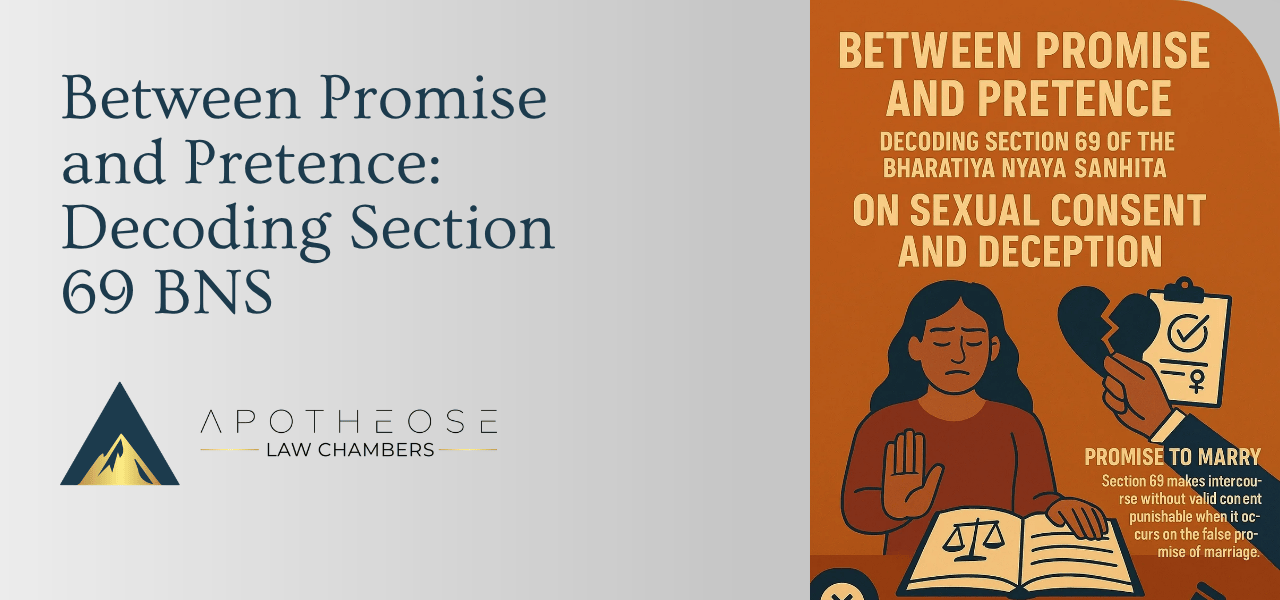
Between Promise and Pretence: Decoding Section 69 of the Bharatiya Nyaya Sanhita on Sexual Consent and Deception
Introduction
The Bharatiya Nyaya Sanhita (BNS), 2023, represents a pivotal transformation in Indian criminal jurisprudence, departing significantly from its colonial predecessor, the Indian Penal Code (IPC) of 1860. Amongst its numerous innovative provisions, Section 69 emerges as particularly noteworthy, addressing the intricate matter of sexual relations obtained through deceptive means, specifically regarding false matrimonial promises. This discourse seeks to analyse Section 69 of the BNS, examining its legal framework, the societal challenges it attempts to resolve, the judicial precedents that influenced its formulation, and the multifaceted debates surrounding it. Through incorporation of pertinent case law and balanced scrutiny, this analysis aims to provide legal practitioners and scholars with a comprehensive understanding of this contentious provision.
The Text and Context of Section 69
The Provision
Section 69 of the BNS, 2023, stipulates:
“Whoever, by deceitful means or by making a promise to marry a woman without any intention of fulfilling the same, and has sexual intercourse with her, such sexual intercourse not amounting to the offence of rape, shall be punished with imprisonment of either description for a term which may extend to ten years and shall also be liable to fine.”
The Rationale
This provision criminalises sexual relations procured through deceptive means, particularly emphasising false matrimonial promises. It endeavours to safeguard individuals, predominantly women, from exploitation in intimate relationships where consent is vitiated by fraudulent means or misrepresentation. This represents an evolution from the previous legal framework, where such matters were typically prosecuted under the broader provisions of rape (Section 375 IPC) or consent obtained under a “misconception of fact” (Section 90 IPC).
The Judicial Journey: From Case Law to Codification
Section 69’s emergence reflects decades of judicial interpretation, where courts wrestled with distinguishing between false marriage promises amounting to rape and mere breaches of trust.
Key Supreme Court Decisions
- Uday v. State of Karnataka (2003)
This seminal judgement saw the Supreme Court acquitting the accused, determining that the prosecutrix, a mature university student, had consented to intimate relations of her own volition, cognisant of the implications. The Court emphasised that not every unfulfilled marriage promise constitutes rape; the critical element is whether the promise was made mala fide, without intention of fulfilment.
2. Yedla Srinivasa Rao v. State of A.P. (2006)
In this case, the Court established that obtaining sexual consent through deliberate false promises of matrimony could constitute rape. The judgement acknowledged that deceptive promises could invalidate consent, particularly when such promises were employed as a pretext to obtain sexual relations.
3. State of U.P. v. Naushad (2013)
The accused faced conviction for procuring sexual consent by falsely promising marriage and subsequently refusing to honour the commitment after the woman’s pregnancy. The Court emphasised the significance of the accused’s intention at the time of making the promise, thereby reinforcing the “intent at inception” doctrine.
4. Pramod Suryabhan Pawar v. State of Maharashtra (2019)
This landmark case crystallised the legal criterion: consent must encompass active, reasoned deliberation; the matrimonial promise must be demonstrably false; and the promise must directly influence the woman’s decision to engage in sexual relations. The Court drew a crucial distinction between a “false promise to marry” and a “mere breach of promise”.
5. Deepak Gulati v. State of Haryana (2013)
The Court emphasised that conviction necessitates proving the accused’s mala fide intentions at the promise’s inception. Unforeseen circumstances preventing marriage cannot automatically be construed as a false promise.
6. Dhruvaram Murlidhar Sonar v. State of Maharashtra (2019)
The Court recognised that not all unfulfilled marriage promises constitute rape, particularly where genuine affection exists. This case further refined the approach to distinguishing between genuine changes of heart and intentional deception.
From Doctrine to Statute
These judgements collectively shaped the doctrine that only those promises made without any intention of fulfilment, i.e., with deceitful intent, should attract criminal liability. Section 69 of the BNS codifies this doctrine, aiming to provide statutory clarity and address the gaps in the previous legal framework.
The Protective Promise: Arguments in Favour of Section 69
- Addressing Exploitation and Gendered Power Imbalances
Section 69 responds to the persistent issue of women being induced into sexual relationships through false marriage promises, only to face subsequent abandonment. In a society where premarital relations carry significant social stigma, such deception can severely impact the victim’s dignity, reputation, and psychological well-being.
2. Legal Clarity and Fair Labelling
By establishing a distinct offence for sexual intercourse obtained through deceitful means, Section 69 ensures legal clarity and fair labelling. It acknowledges that whilst not all such cases constitute rape, they nonetheless represent serious violations of autonomy and trust.
3. Deterrence
The provision acts as a deterrent against those who might otherwise exploit others’ trust and vulnerability for sexual gratification, knowing that such conduct is now explicitly criminalised.
4. Alignment with Social Norms
Section 69 signifies a societal evolution towards acknowledging and sanctioning deceptive practices in intimate relationships, harmonising legal frameworks with modern expectations of truthfulness and dignity in matters of consent.
The Perils of Overreach: Criticisms and Concerns
1. Potential for Misuse
A primary critique of Section 69 centres on its susceptibility to misapplication. Legal scholars contend that the provision might be exploited in the wake of terminated relationships, potentially leading to vexatious complaints filed as instruments of emotional vengeance or social retribution.
2. Subjectivity and Evidentiary Challenges
Establishing “intent at inception”—demonstrating that the accused harboured no genuine matrimonial intentions and employed the promise merely as a stratagem for sexual relations—presents inherent complexities. Given the multifaceted nature of relationships and the fluidity of human intentions, there exists a risk of criminalising legitimate changes in sentiment or ensnaring innocent parties.
3. Over-Criminalisation of Consensual Relationships
Section 69 potentially risks excessive criminalisation of consensual intimate relationships between adults, particularly when such relationships conclude acrimoniously. Critics maintain that the provision lacks the sophisticated judicial safeguards developed through precedent and might compromise individual autonomy in intimate matters.
4. Ambiguity and Overlap with Other Provisions
The provision’s broad phraseology and absence of a non-obstante clause engender ambiguity and potential confluence with other statutory provisions, notably Section 63 of the BNS (rape). This might precipitate juridical uncertainty and inconsistent application.
5. Social and Cultural Backlash
Within a society where notions of honour and chastity remain deeply embedded, Section 69 risks reinforcing patriarchal paradigms, potentially casting women as perpetual victims and men as presumptive offenders, thereby undermining female agency and perpetuating societal stereotypes.
Comparative Perspectives: How Do Other Jurisdictions Address Deceptive Consent?
Whilst Section 69 is particular to India, the matter of consent vitiated by fraud or misrepresentation transcends jurisdictional boundaries. Comparative jurisprudence offers illuminating parallels:
United Kingdom: The Sexual Offences Act 2003 stipulates that consent obtained through deception regarding the nature or purpose of the act, or the perpetrator’s identity, may vitiate consent and constitute rape. However, British law adopts a narrower approach, emphasising deception about the act itself or perpetrator identity rather than promises concerning future conduct.
United States: Certain states criminalise “rape by deception,” though generally limiting its scope to cases involving deception about the act’s nature or perpetrator’s identity.
Prosecution of cases involving deception about future intentions (including marriage) remains uncommon.
Other Civil Law Jurisdictions: Whilst numerous civil law nations acknowledge that fraudulently obtained consent can nullify contractual agreements, the application of this doctrine to sexual relations remains less prevalent and often contentious.
These jurisdictional comparisons underscore that India’s approach through Section 69 is markedly comprehensive, reflecting both its distinctive sociocultural framework and the progressive jurisprudence concerning consent and individual autonomy.
The Social Impact: Numbers and Narratives
Prevalence and Patterns
Research indicates that amongst 410 documented cases of sexual assault, 29% involved complainants aged 16-18 years, highlighting young women’s susceptibility to deceptive consent. Whilst not all instances involved false matrimonial promises, these statistics emphasise the pervasiveness of sexual exploitation through fraudulent means.
Societal Consequences
The societal ramifications of deceptive sexual relations are substantial. Victims frequently encounter social stigmatisation, community exclusion, and psychological distress. Thus, the law serves not merely as a punitive mechanism but as an instrument signalling society’s condemnation of such behaviour.
The Need for Legal Clarity
Legal scholars advocate for a distinct juridical framework addressing deceptive sexual relations, emphasising fair labelling principles and the necessity to differentiate between genuine relationships and those vitiated by fraud.
Consent, Deceit, and the Law: A Broader Perspective
Consent in Indian Law
The notion of “free consent” remains fundamental to both criminal and contract law. The Indian Contract Act, 1872, stipulates that consent obtained through coercion, undue influence, fraud, misrepresentation, or mistake is not free. This principle underpins Section 69: sexual consent, akin to contractual consent, must be informed and voluntary.
Fraud and Misrepresentation
Section 17 of the Contract Act defines fraud to include promises made without intention of fulfilment. Courts consistently hold that contracts entered under fraud or misrepresentation are voidable. Section 69 extends this principle to intimate relations, acknowledging that deceit vitiates consent in both personal and commercial spheres.
The Digital Age
The proliferation of virtual relationships and digital communications has complicated the task of establishing deceit and intent. Legal scholars advocate legislative reforms addressing modern relationship dynamics and evolving consent paradigms.
Striking a Balance: Recommendations and the Way Forward
1. Clearer Guidelines and Safeguards
Legal experts recommend precise guidelines for Section 69’s application, including structured protocols for intent and consent assessment. Mandatory preliminary inquiries could filter spurious complaints.
2. Judicial Caution and Discretion
Courts must maintain vigilance in distinguishing genuine changes of heart from intentional deception. The nuanced jurisprudential approach should guide Section 69’s interpretation.
3. Public Awareness and Education
Legal reforms must be complemented by comprehensive public awareness initiatives to enlighten individuals regarding consent’s legal implications, the ramifications of deceptive practices, and the paramount importance of maintaining truthfulness in interpersonal relationships.
4. Comparative Learning
India can derive valuable insights from international jurisdictions, incorporating exemplary practices whilst remaining cognisant of its distinctive sociocultural fabric. Such comparative juridical analysis can facilitate the refinement of legal frameworks, ensuring the dual objectives of justice and equitability.
Conclusion
Section 69 of the Bharatiya Nyaya Sanhita represents a significant legislative endeavour to address the nuanced territory between consensual sexual relations and exploitation through deception. This provision emerges from judicial wisdom, societal imperatives, and evolving consent jurisprudence. However, like all legislative measures governing intimate relationships, it necessitates careful balance between protection and interference. The crucial task before legislators, judiciary, and society is ensuring Section 69 fulfils its protective mandate without becoming susceptible to misuse or impeding legitimate relationships. As jurisprudence continues to develop, maintaining an open dialogue, anchored in both empathy and rationality, becomes imperative to ensure justice is both delivered and manifestly apparent.