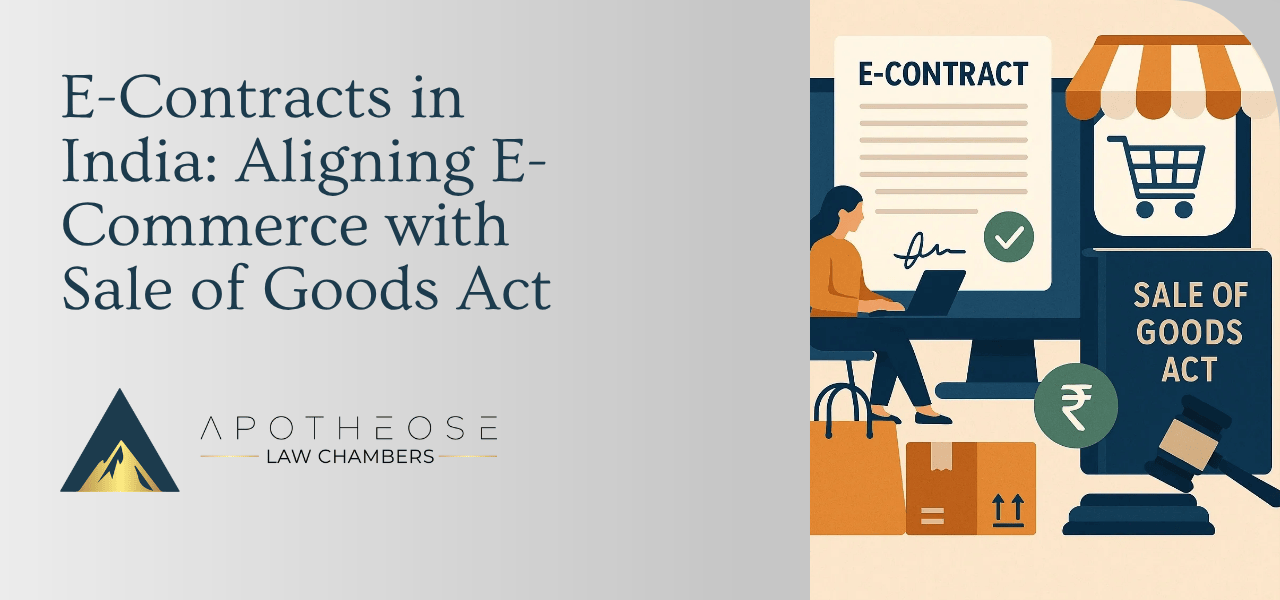
The development of internet shopping in India has changed the way people buy and sell things, leading to the creation of electronic contracts. There are a lot of legal issues to think about throughout this change, especially when it comes to the Sale of Goods Act of 1930, which was made for transactions that happened in person. As more and more people buy and sell things online, it’s important to look into how these laws apply to digital contracts and whether the current laws are good enough to deal with the unique problems of the online marketplace. This study looks at how well electronic contracts fit with the Sale of Goods Act, 1930, and the legal and practical problems that can come up in this digital world. The Act’s rules on fulfilling contracts, delivering items, and making payments were originally meant for physical exchanges. However, they are now being used in online commerce, even though the digital world has its own set of problems. Chapter IV of the Sale of Goods Act, 1930 talks about how contracts are carried out on websites that sell things. A vendor has to deliver the products, no matter who owns them or who has them right now. On the other hand, the buyer must take these items and pay for them as the contract says they will. The phrase “in accordance with the terms of the contract of sale” makes it clear that the parties can change these basic terms if they choose to.
Customers can choose from a number of payment methods when they shop online, and once they do, they have to utilise that method. Delivering items is an important part of fulfilling the contract, and we have looked at each part of the delivery process in the context of electronic contracts. Section 32 of the Act says that payment and delivery must happen at the same time. This means that the seller must be ready to provide the buyer the goods when the buyer is ready to pay for them, and the buyer must be ready to pay for the items when the seller is ready to give them to the buyer.
DROPSHIPPING IS BECOMING MORE IMPORTANT IN INTERNATIONAL TRADE
Dropshipping is a way for stores to sell things without having to keep stock. Instead, third-party providers fill consumer orders and send the items on the seller’s behalf. This concept has made it possible for people and small businesses to get into global marketplaces with little money up front. One of the best things about dropshipping is that it doesn’t require you to store things or spend a lot of money. Entrepreneurs may sell a lot of different things without having to worry about the cost of keeping them in stock. It also gives you options, so you may easily try out new things or enter new marketplaces. These advantages have made dropshipping more appealing to small and medium-sized businesses (SMEs), which helps them compete more fairly in international e-commerce. The dropshipping market is growing significantly. Experts in the field think its worth will rise to $435 billion by 2025 and then to more than $537.8 billion by 2026. This fast increase shows that it is having a bigger impact on internet sales around the world. Dropshipping is changing traditional supply networks in addition to having an economic effect. Sellers no longer handle inventory; instead, they help customers and suppliers work together. This makes supply networks more flexible and able to change. But there are problems with international dropshipping as well. Shipping periods are often lengthier for businesses, and the process of importing goods can be complicated. The quality of the products might be uneven, and businesses may not have as much control over the client experience. Supplier reliability can also vary.In the future, technology is likely to be very important to the growth of dropshipping. Artificial intelligence is helping to automate product selection, marketing, and customer care, which makes it easier for sellers to run their businesses internationally. Blockchain technology could make the supply chain more open and assist show that products are real. At the same time, automation software is making it easier to keep track of orders and update inventory.
HOW TECHNOLOGY AFFECTS THE SIGNING OF CONTRACTS
The way contracts are handled has changed a lot because of modern technology. The whole process is now faster, clearer, and safer. For instance, “smart contracts” that employ blockchain technology can automatically carry out the provisions of an agreement once the agreed-upon circumstances are met. This speeds up transactions, cuts costs, and makes ensuring that commitments are met on time. Artificial intelligence (AI) tools also make things easier by helping with things like writing contracts, keeping track of compliance, monitoring potential risks, and making sure contracts are followed. Digital signatures and other techniques to prove someone’s identity are a legal alternative to traditional signatures.They speed up the process of signing contracts, especially when people are working from home or online. Blockchain technology also lets you keep records in a method that is both decentralised and safe. This means that they can’t be changed and there is a clear history for settling any disputes.
LOOKING AT WHAT GOODS MEAN IN THE SALE OF GOODS ACT, 1930
The Sale of Goods Act of 1930 says that “goods” are all kinds of movable property, except for money and claims that can be taken to court. This broad definition encompasses things that can be moved, such stocks, shares, crops, grass, and even things that are attached to property, as long as they are agreed to be removed before the sale or as part of the sale deal.
The Act is mostly about things that can move. Land and buildings, which are not moveable, are not protected. Claims that can be acted on, which are rights instead of goods, and money or legal cash used in ordinary transactions are also not included. Coins or money that are no longer in circulation and are worth more than their face value may be considered “goods” because of their worth. The Act makes it plain what it means by “movable property” by giving certain examples. For example, stocks and shares show that you control a corporation, and crops or grass that you raise are considered products if you consent to cut them down before or during the sale. In the same way, things like wood or fixtures that are linked to land are only deemed goods if the buyer agrees to take them away as part of the transaction.
CASE REPORT: AMAZON SELLER SERVICES PVT. LTD. V. AMWAY INDIA ENTERPRISES PVT. LTD. & OTHERS
I. FACTS
Amway India Enterprises Pvt. Ltd., Modicare Ltd., and Oriflame India Pvt. Ltd. (Direct Selling Entities – DSEs) use a direct selling model, which means they only sell their products through approved distributors and make it clear that they do not allow sales on third-party e-commerce sites. Still, their goods were located for sale on big e-commerce sites including Amazon, Flipkart, Snapdeal, and 1MG.
· The DSEs took legal action, claiming that these illegal web sales:
· Broke the rules for their registered trademarks.
· Damaged the reputation of their brand.
· Led to contract violations between the DSEs and their distributors.
· The Ministry of Consumer Affairs issued the Direct Selling Guidelines (DSGs) in 2016.
They asked for an injunction to stop e-commerce sites from selling or helping to sell their products without their authorisation.
II. ISSUES
· If selling DSE products on e-commerce sites was a violation of trademark law.
· The fact that the 2016 Direct Selling Guidelines are legally binding and can be enforced against third parties.
· If e-commerce sites were breaking contracts on purpose.
· If the Information Technology Act, 2000, said that e-commerce platforms were “intermediaries,” they would have been able to get “safe harbour” protection.
· If the theory of trademark exhaustion allowed real things to be sold online without the brand owner’s permission.
III. JUDGMENT
SINGLE JUDGE’S RULING (2019):
· The Single Judge first found in favour of the direct selling companies and gave them a temporary injunction.
· It was decided that the Direct Selling Guidelines applied to everyone.
· It turned out that e-commerce sites were not only middlemen; they also
stored, packaged, and sold goods.
· They came to the conclusion that platforms made it easier for people to sell things without permission, which led to trademark violations and broken contracts.
· Made it illegal to sell DSE products without explicit permission.
DIVISION BENCH’S DECISION ON APPEAL (2020):
· The interim injunction was lifted when the Delhi High Court’s Division Bench reversed the Single Judge’s decision.
· Direct Selling Guidelines: It was decided that the 2016 Direct Selling Guidelines could not be applied to platforms that had not signed them because they were only recommendations and not legally binding.
· Trademark Exhaustion: Sections 30(3) and 30(4) of the Trade Marks Act, 1999, stipulate that trademark rights are exhausted upon the first lawful sale of goods. This means that subsequent sales of authentic products do not violate the trademark unless their integrity or condition is materially changed.
· E-commerce websites such as Amazon and Flipkart were deemed to be “intermediaries” for the purposes of Section 2(w) of the Information Technology Act of 2000. As a result, they were granted “safe harbour” protection under Section 79, as long as they took reasonable precautions.
· Absence of Proof for Tampering: determined that there was not enough proof of product tampering or poor quality to support an interim injunction, arguing that such factual disputes needed a full trial.
· The Division Bench granted the appeal, lifting the temporary ban on e-commerce sites selling authentic DSE goods. The trial court was ordered to decide the case’s factual merits.
IV. RATIO DECIDENDI
There were three main reasons why the Division Bench made its decision:
· Not Binding Nature of Direct Selling Guidelines: The court made it clear that the Direct Selling Guidelines of 2016 were executive orders and advice, not laws. So, they couldn’t make third-party e-commerce platforms legally responsible for anything.
· The court used the notion of trademark exhaustion, which is included in Sections 30(3) and 30(4) of the Trade Marks Act, 1999. This rule says that the brand owner loses the right to control the resale of a real product with a trademark after it has been sold (the “first sale”). However, this is only true if the goods have not been materially changed or damaged after they were put on the market.
· The IT Act, 2000 gives intermediaries Safe Harbour Protection: The Information Technology Act, 2000 says that e-commerce platforms are “intermediaries.” As a result, they were given “safe harbour” protection under Section 79 of the IT Act. This means that intermediaries are not responsible for third-party information as long as they do their due diligence and meet specific standards. In this case, the court decided that the e-commerce platforms met these standards.
CONCLUSION
E-commerce and dropshipping have changed the way people buy and sell things in India, which has shown how outdated laws like the Sale of Goods Act, 1930 are. The Act was first made for regular, in-person business deals that involved physical items. Now, though, it is being used in a very different world, one that is driven by digital platforms, electronic contracts, and supply chains that span borders. The Act’s basic requirements for performance, delivery, and payment still apply, but they don’t always work well for the specifics of doing business online. In the case of Amazon Seller Services Pvt. Ltd. v. Amway India Enterprises Pvt. Ltd., the Delhi High Court had to deal with difficult problems such illegal sales, intermediary liability, and whether or not executive directions could be enforced. The decision illustrated how hard it is to protect the integrity of a brand while also making sure that consumers can get to it and that the market is open. It also revealed how weak the regulations are when it comes to online platforms and how little authority government-issued rules have in court.
Blockchain, smart contracts, and AI are all new technologies that are transforming the way contracts are made and carried out. These innovative ideas make it easier, faster, and safer to make and maintain promises, especially in a digital age where people may never meet in person. Smart contracts, for example, can automatically carry out transactions based on rules that have already been set. Blockchain, on the other hand, keeps a permanent record of the history of contracts and the movement of goods. This creates confidence and minimises the number of disputes.
Dropshipping, whether for real or digital goods, is one of the issues that e-commerce faces today. Sellers rely on third-party suppliers for inventory and shipping when it comes to physical goods. This might make them worry about shipping delays, quality control, and customer happiness. Digital items are easier to move around, but they also come with more legal and operational problems when it comes to licenses, access, and refunds. Neither model gives sellers direct control over manufacturing or inventories. This makes us rethink what we used to consider about seller liability and contractual responsibility.
India’s business rules need to be changed right now because of these changes. Changes need to be made to the Sale of Goods Act and other laws that deal with sales to accommodate online sales, sales on platforms, and new technologies. This will not only make things safer and clearer for everyone involved—sellers, buyers, and middlemen—but it will also build trust among consumers and inspire new ideas in the digital economy. To keep up with the future of business, the law needs to be as agile and adaptable as the technologies and business models it tries to control.