OVERVIEW
Creativity is a talent inherent in a particular human however, with the help of Artificial Intelligence such talent can be generated. It will take a human intensive research, brainstorming, and creative writing and lot more sweat which now AI can do within minutes.
The use of generative artificial intelligence (AI) has the potential to transform the way businesses run by automating tedious operations and producing innovative new designs and products. However, there are also legal ramifications to take into account with any new technology.
Intellectual property rights are one of the main legal concerns of employing generative AI for business purposes. The issue of who owns the rights to these works arises when generative AI is used to produce new goods or designs. The output of generative AI is frequently a “joint work,” with the AI system and the human users each owning a portion of the rights. The precise ownership and distribution of rights, however, can be complicated and vary depending on the facts of each instance.
GENERATIVE AI: CHATGPT
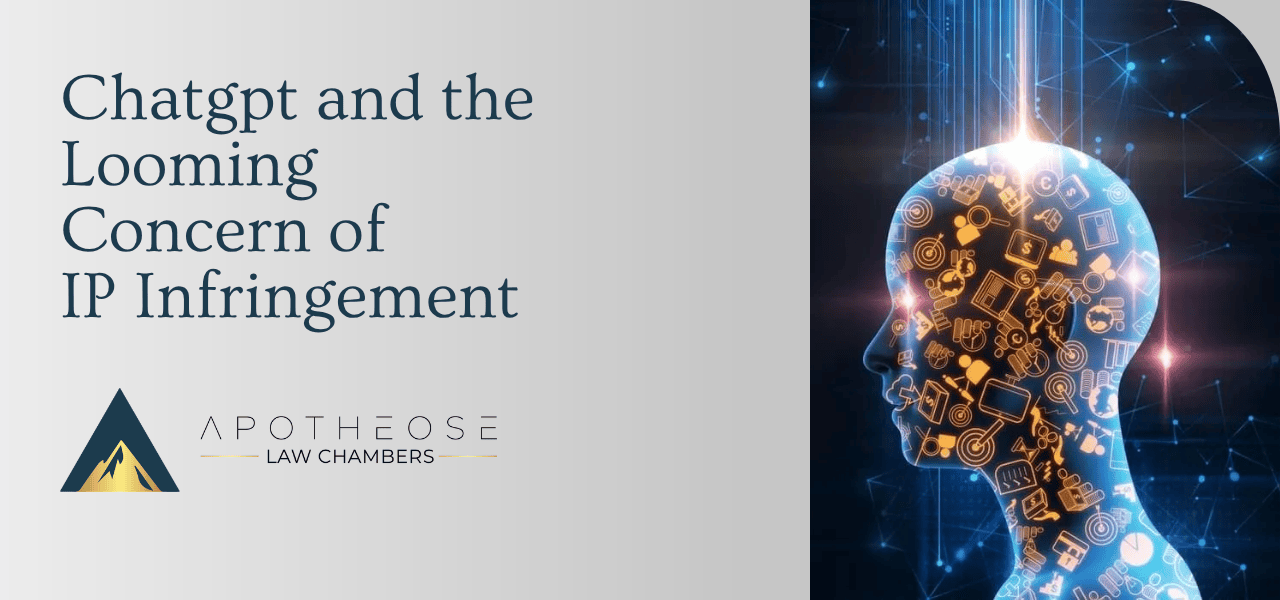
Artificial intelligence that can create fresh content, such text or graphics, is referred to as generative AI. Complex machine learning models used in generative AI software have been honed using vast amounts of publicly accessible data, including websites, photos, and videos, among others. These machine learning models are used by the programme to predict the subsequent word based on the preceding word sequences, and so on, until the entire passage of text is generated. comparable to how it predicts the next piece of an image based on previous images that include comparable portions, the software employs machine learning models to build entire images.
At their places of employment, many professionals have begun utilising generative AI technologies, for instance to create blog posts, emails, and images. Some have even dared to utilise ChatGPT as an automated chatbot. However, professionals frequently employ these generative AI systems without fully comprehending the commercial and legal concerns involved.
As stated by ChatGPT, the AI will not own the stuff it creates, even though it may be copyrighted. In fact, AI cannot possess copyright under European (and US) law since it cannot be recognised as an author and lacks the legal personality required to hold (intangible) assets.
As ChatGPT is “just” an artificial intelligence, it cannot own anything it publishes. Even though it is based on an already-existing piece of information, it elaborates replies from the facts it has collected in its database and so produces a new answer. This answer might be covered by copyright, but that relies on whether it qualifies as a “work” — something that represents the author’s creative choices.
DILEMMAS
Talking about the issues, firstly, Misappropriation of Trade Secrets[2] that is, ChatGPT generates text that can include confidential information or business plans, which are unauthorized to be shared. Generative AI models are trained on massive amounts of publicly available data including copyrighted data. There are concerns that the use of copyrighted data to train these machine learning models violates the copyrights of the copyright owners.
Another problem is that some people have been vehemently protesting that generative AI might be stealing intellectual property from people who have developed stuff. The majority of generative AI applications train their data sets by looking at online data. Based on such data, the algorithms can develop a sizable internal pattern-matching network within the AI software, which can then produce seemingly new content that astonishingly appears to have been created by a human hand rather than a machine. Many tasks that were previously carried out by people can be automated by AI systems, which may significantly alter the employment environment. Organizations must ensure that they comply with all relevant employment laws and regulations, including fair selection processes for which tasks will be automated and providing appropriate training and support to affected employees.
Furthermore, it is not obvious if the content produced by AI chatbots would be regarded as original and fixed in a tangible form, and consequently be eligible for copyright protection. Some may contend that as an AI[3] is only a tool or instrument utilised by a human author to produce the work, the human author should be regarded as the work’s originator and owner. Others would contend that, given its capacity to produce original content without human input, the AI itself ought to be treated as the author and proprietor of the work. Liability could ensue if the authorship is not correctly credited. It may specifically be against the terms of use of some generative AI systems, some of which prohibit the author from claiming that the output from the generative AI programme was produced by humans when it was not. Additionally, failing to indicate that generative AI was used to create the material could lead to accusations of misrepresentation once they are discovered because the identical output could be generated for another user.
Another is that generative AI systems are excellent at creating content autonomously. However, the generated content might not be factually accurate. The idea of hallucinations, or the ability of generative AI to create information that appears accurate but is false, is one of the main problems with these systems.
CONCLUSION
As a result, ChatGPT is unquestionably a useful tool in a variety of industries, including the intellectual property sector. However, caution should be exercised when “feeding it” sensitive information because doing so risked spoiling the novelty or jeopardising the security of trade secrets.
Automating monotonous chores, developing new goods and designs, and changing how firms run are all potential outcomes of generative AI. Organisations, however, need to be cognizant of the legal ramifications of utilising generative AI in the workplace.
In general, the development of next-generation AI tools presents significant IP issues that must be resolved in order to guarantee that these technologies are utilised morally and in a way that respects the rights of human creators. To create acceptable legal frameworks for the use of AI in the production of creative material, technologists, lawyers, and legislators will need to carefully weigh these problems and collaborate. While AI chatbots have the potential to be effective tools for maximising human productivity, there are worries about how they may impact the legal industry.
[1] ChatGPT and the Underlying Copyright Malady, available at;
https://spicyip.com/2023/03/ai-and-copyright-law-analysing-the-impact-of-chatgpt.html(visited on 18 April 2023).
[2]CHATGPT : IMPACT, RISKS AND LEGAL QUESTIONS REGARDING IP LAW, available at;
Blog Cyberjustice – ChatGPT : impact, risks and legal questions regarding IP Law(visited on 18 April 2023).
[3]Exploring the Legal Minefield of ChatGPT and Intellectual Property Rights, available at;
Exploring the Legal Minefield of ChatGPT and Intellectual Property Rights – Falcon Rappaport & Berkman LLP (frblaw.com) (visited on 18 April 2023).