INTRODUCTION
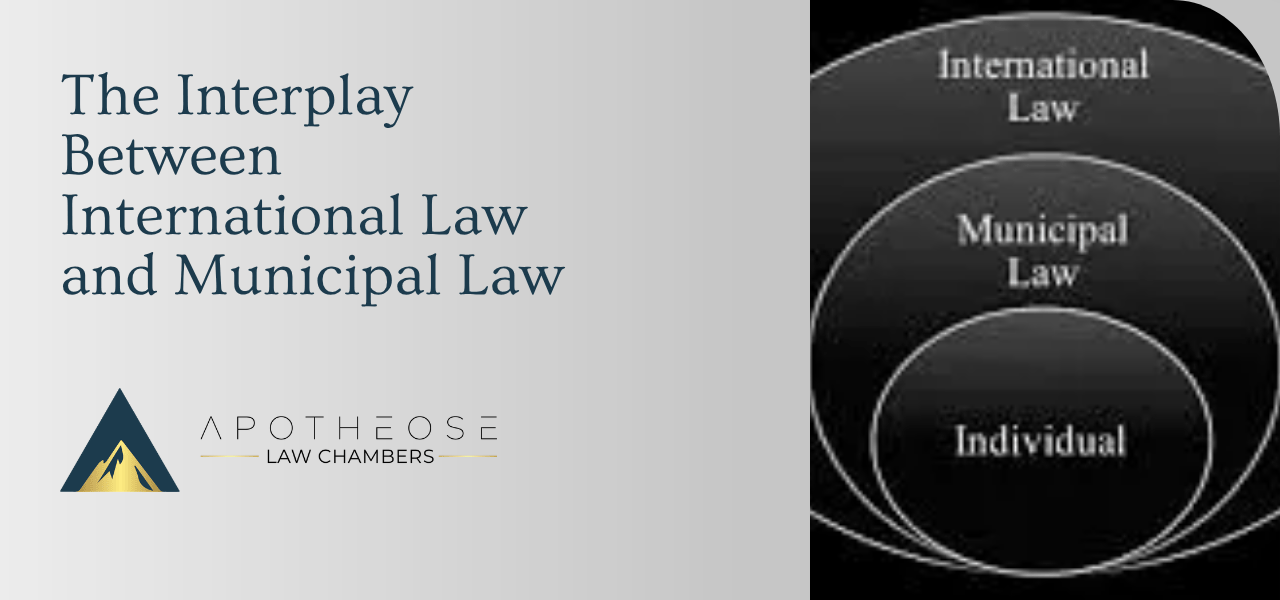
The coexistence of international law and municipal law raises fundamental questions about the hierarchy of legal norms, the enforcement mechanisms, and the impact of one legal system on the other. International law, as the body of rules and norms that govern relations between states and other international actors, operates on a global scale. Municipal law, on the other hand, is the legal framework within a sovereign state that regulates the conduct of individuals and entities within its borders. Understanding the relationship between these two legal systems requires an examination of their origins, sources, and how they interact in practice.
HISTORICAL DEVELOPMENT
The historical development of the relationship between international law and municipal law is rooted in the Westphalian system, where the principle of state sovereignty emerged as a cornerstone of the international order. During this period, states were considered as independent entities with the authority to govern their internal affairs without interference from external actors. However, as the world became more interconnected through trade, diplomacy, and conflict, the need for rules governing interstate relations became evident.
The rise of international law in the 19th and 20th centuries, marked by the establishment of international treaties and institutions, challenged the traditional notion of absolute state sovereignty. Treaties, as a primary source of international law, required states to modify their domestic legal frameworks to comply with their international obligations. This paved the way for the incorporation of international law into municipal legal systems, often through mechanisms such as dualism and monism.
DUALISM AND MONISM
A. DUALISM:
In a dualist system, international law and municipal law are treated as separate and distinct legal orders. This means that for international law to have direct effect within a state’s domestic legal system, a specific act is required to transform international norms into municipal law. This act typically involves domestic legislation or executive action.
- Distinct Legal Orders: In a dualist framework, international law and municipal law coexist but do not automatically influence each other. They are considered distinct legal realms with their own sources, principles, and authorities.
- Legislative Action for Implementation: States adhering to dualism typically require specific legislative action to give effect to their international obligations. This process involves incorporating international treaties or conventions into domestic law through the passage of legislation.
- Parliamentary Supremacy: The principle of parliamentary supremacy is often crucial in dualist systems. This principle asserts that domestic law prevails in the event of a conflict between international norms and municipal laws. In this way, states maintain control over the integration of international law into their legal systems.
B. MONISM:
In contrast, monism posits that international law and municipal law form a unified legal order. Under monism, international law is automatically recognized and considered an integral part of the domestic legal system without the need for additional legislative measures.
- Unified Legal Order: Monism envisions a seamless integration of international and municipal law, treating them as parts of a single legal order. This approach reflects a more harmonized view of the relationship between the two legal systems.
- Automatic Applicability of International Norms: In monist systems, international norms are regarded as self-executing and directly applicable within the national legal framework. Courts may apply international treaties without the need for separate enabling legislation.
- Harmonization of Legal Principles: Monism emphasizes the harmonization of legal principles at the international and domestic levels. This perspective reduces the need for states to engage in a specific legislative process to implement international obligations.
INCORPORATION OF INTERNATIONAL LAW INTO MUNICIPAL LAW
The incorporation of international law into municipal law is a critical aspect of understanding the relationship between these two legal systems. This process involves the translation of international obligations into domestic legal norms, allowing states to comply with their international commitments within their national legal frameworks. The two main conceptual frameworks that govern this incorporation are dualism and monism.
Dualism:
Dualism posits that international law and municipal law are distinct legal orders, and a separate act is required to transform international norms into domestic law. In dualist systems, there is a clear separation between the domestic legal system and international legal obligations. The principle of dualism reflects a commitment to the autonomy of the national legal order and the idea that international law does not automatically become part of domestic law.
When a state becomes a party to an international treaty or convention, the domestic legal system in a dualist state does not automatically recognize and apply the treaty’s provisions. Instead, the state must take additional steps, such as passing legislation or adopting specific measures, to give effect to its international obligations domestically. This legislative or executive action is necessary to bridge the gap between the international legal commitment and its incorporation into the national legal framework.
Dualist systems often uphold the principle of parliamentary supremacy, where domestic law prevails over international law in case of a conflict. This reflects the idea that, in dualist systems, international law is not automatically superior to domestic law and requires a specific domestic act for implementation.
Monism:
In contrast, monism suggests that international law and municipal law are part of a single legal order. In monist systems, international law is automatically integrated into domestic law without the need for additional legislation or measures. Monism recognizes international law as self-executing and directly applicable within the domestic legal system.
When a monist state becomes a party to an international treaty, the provisions of the treaty are considered an integral part of the national legal framework. Courts in monist systems can directly apply international law in cases before them, treating international norms as binding on individuals and entities within the state’s jurisdiction.
Monist systems often emphasize the harmonization of domestic and international legal obligations. In these systems, there is a presumption that international law is superior to conflicting domestic law, and domestic courts have the authority to apply and enforce international norms without the need for explicit domestic legislation.
Case Examples:
- Dualism in the United Kingdom:
- The United Kingdom is often cited as an example of a dualist system. In the UK, international treaties do not automatically become part of domestic law. To be enforceable in domestic courts, treaties must be incorporated through legislation. An example is the Human Rights Act 1998, which incorporates the European Convention on Human Rights into UK law.
- Monism in Germany:
- Germany, on the other hand, operates under a monist system. International treaties automatically become part of German law without the need for additional legislation. The German constitution (Grundgesetz) recognizes the binding force of international law and allows individuals to invoke international treaties before domestic courts.
CHALLENGES TO THE RELATIONSHIP
- Sovereignty Concerns: One of the primary challenges to the relationship between international law and municipal law stems from the concept of state sovereignty. States traditionally view themselves as independent entities with the authority to govern their internal affairs without external interference. When international law imposes obligations that require changes to domestic legal frameworks, states may perceive this as an infringement to their sovereignty. This tension is particularly evident in areas such as human rights, where international norms may clash with domestic practices and policies.
- Enforcement Deficiency: The lack of a centralized enforcement mechanism is a significant obstacle to the effective implementation of international law. Unlike domestic law, where a state’s legal system has the authority to enforce laws through its judiciary and law enforcement agencies, international law relies on the voluntary compliance of states. The absence of a global enforcer limits the capacity to ensure that states adhere to their international obligations, allowing some states to disregard these commitments without facing meaningful consequences.
- Conflicting Priorities: States often face the challenge of reconciling conflicting priorities between international obligations and domestic interests. In areas such as environmental protection or trade, international agreements may require states to make policy adjustments that are not aligned with their immediate national interests. Balancing these conflicting priorities becomes a delicate task, and states may be tempted to prioritize short-term gains over long-term global benefits, undermining the effectiveness of international law.
- Effective Implementation in Domestic Legal Systems: The effectiveness of international law often depends on its successful integration into domestic legal systems. In dualist systems, where an additional legislative act is required to give effect to international norms, delays or failures in the legislative process can hinder the timely implementation of international obligations. This may lead to gaps in legal protection and enforcement, limiting the impact of international law at the national level.
- Lack of Global Enforcement Mechanism: Unlike municipal law, where a state’s legal system has the authority to enforce laws, international law lacks a centralized global enforcement mechanism. While international institutions, such as the International Court of Justice (ICJ) and the International Criminal Court (ICC), exist to adjudicate disputes and prosecute individuals for certain crimes, their jurisdiction is limited, and their decisions may not always be enforceable. This limitation poses a challenge to the efficacy of international law in ensuring compliance with its provisions.
- State Practice and Customary International Law: The formation of customary international law relies on consistent state practice accompanied by a belief that such practice is legally required (opinio juris). However, the challenge arises when state practice is inconsistent or when states assert that certain actions are not reflective of a customary obligation. Divergent interpretations of customary international law complicate its application in domestic legal systems, leading to uncertainty and potential conflicts.
Addressing these challenges requires a nuanced understanding of the delicate balance between the sovereign rights of states and the collective interests of the international community. Efforts to strengthen the relationship between international law and municipal law should consider mechanisms for effective enforcement, methods for reconciling conflicting priorities, and strategies to enhance the integration of international norms into domestic legal frameworks.
THE ROLE OF DOMESTIC COURTS
Domestic courts play a crucial role in shaping the relationship between international law and municipal law. The doctrine of incorporation allows national courts to apply and enforce international law within the domestic legal system. In dualist systems, the judiciary often relies on domestic legislation to give effect to international norms, while in monist systems, courts may directly apply international treaties as part of the national legal framework.
The decisions of domestic courts can have far-reaching implications for the relationship between international and municipal law. Landmark cases, such as the Pinochet case in the United Kingdom or the ATS (Alien Tort Statute) cases in the United States, have demonstrated the ability of domestic courts to adjudicate matters with international implications. These cases underscore the interconnectedness of the two legal systems and the potential for domestic courts to act as enforcers of international norms.
REGIONAL INTEGRATION AND INTERNATIONAL LAW
The relationship between international law and municipal law is further complicated by the emergence of regional integration organizations. These organizations, such as the European Union, ASEAN, and Mercosur, create supranational legal frameworks that coexist with the domestic legal systems of their member states. The interaction between these regional legal orders and international law adds another layer of complexity to the relationship, as states navigate between competing sources of legal authority.
Regional integration can both complement and challenge the application of international law at the national level. On one hand, regional organizations often adopt international legal principles and standards, reinforcing their implementation within member states. On the other hand, conflicts may arise when regional norms diverge from broader international norms or when states prioritize regional interests over global obligations.
CONTEMPORY ISSUES
The contemporary landscape of international relations presents new challenges to the relationship between international law and municipal law. Issues such as cyber warfare, climate change, and global health crises require collaborative efforts on a global scale, pushing the boundaries of traditional legal frameworks. The effectiveness of international law in addressing these challenges depends on the willingness of states to adapt their domestic legal systems to the evolving demands of the international community.
In the realm of human rights, for example, the extraterritorial application of international norms raises questions about the jurisdiction of domestic courts to adjudicate cases involving actions outside their borders. The tension between national security concerns and human rights obligations underscores the delicate balance that states must strike in navigating the relationship between international and municipal law.
CONCLUSION
The relationship between international law and municipal law is a dynamic interplay shaped by historical developments, legal doctrines, and contemporary challenges. As the world becomes more interconnected, the need for a harmonious and effective relationship between these legal systems becomes increasingly evident. The evolution of this relationship reflects a delicate balance between state sovereignty and the demands of a globalized society.
The principles of dualism and monism offer conceptual frameworks for understanding how international law is incorporated into municipal legal systems. The role of domestic courts, regional integration organizations, and evolving global issues further contribute to the complexity of this relationship. While challenges persist, including issues of enforcement and conflicting priorities, the relationship between international law and municipal law remains a cornerstone of the global legal order.
In conclusion, fostering a cooperative and mutually reinforcing relationship between international and municipal law is essential for addressing the complex challenges of the 21st century. States must navigate this relationship with a commitment to upholding the rule of law, promoting human rights, and finding innovative solutions to global issues that transcend national borders. The ongoing evolution of this relationship will shape the future of the international legal order and the ability of states to collaborate in the pursuit of a just and peaceful world.